Water Supply Planning for Duplex & Villas: A Complete Guide to Getting It Right from Day One
When it comes to building a duplex or villa, most homeowners and builders focus heavily on structural design, interior aesthetics, and landscaping. However, one of the most critical yet frequently overlooked aspects of residential construction is water supply planning. A poorly planned water supply system can lead to chronic low pressure issues, unequal water distribution between floors, frequent pipe repairs, and long-term structural damage due to leakages. At GK Home Construction, we believe that smart water planning from the very beginning is what separates a comfortable home from a troublesome one.
Understanding the Water Demand of a Duplex or Villa
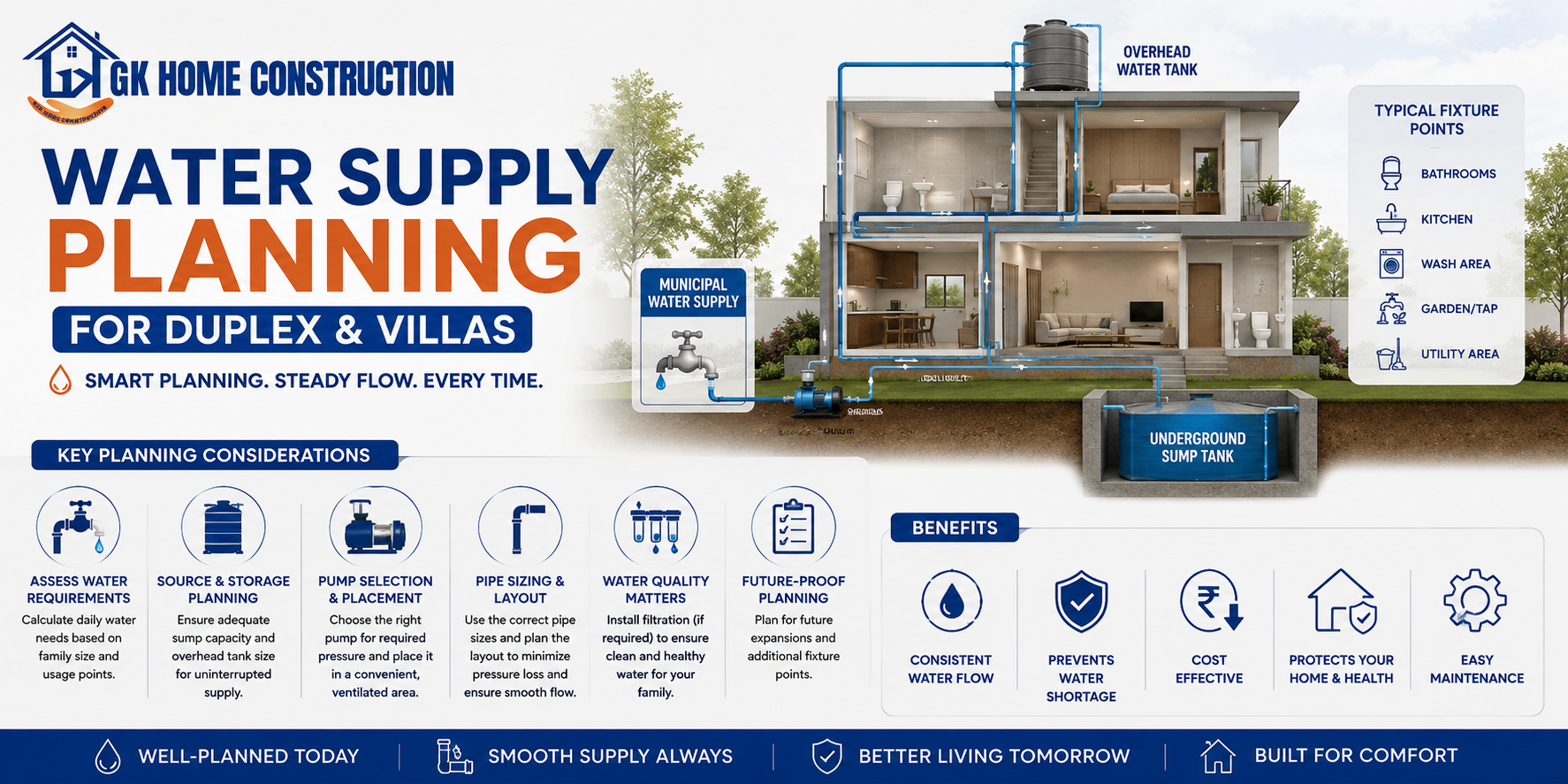
Before laying a single pipe, it is essential to calculate the total daily water requirement of the property. A duplex, by nature, houses two independent families within a shared structure, while a villa typically accommodates a larger single family with multiple bathrooms, a kitchen, utility areas, and sometimes a garden or swimming pool. The average water consumption per person per day in Indian urban households is approximately 135 litres, as recommended by the Bureau of Indian Standards. For a duplex housing two families of four members each, that translates to over 1,000 litres of daily demand. For a villa with a garden, pool, or additional amenities, the requirement can easily scale to 3,000 to 5,000 litres per day. Accurately estimating this demand determines the size of your water storage tanks, the capacity of your pumping system, and the diameter of your supply pipes.
Designing the Distribution Network
The internal water distribution network is the backbone of your entire supply system. In a duplex, it is advisable to design two completely independent supply lines — one for each unit — even if both units share a common overhead or underground tank. This prevents disputes between co-occupants regarding usage and makes individual metering possible if required. For villas, the distribution system must account for every point of use across all floors, including ground-floor kitchens, bathrooms, servant quarters, overhead terraces, garden taps, and car wash points. The pipe sizing must be done progressively, with larger diameter pipes at the main supply and gradually reducing sizes as the lines branch into individual fixtures. Using a thumb rule of 15mm pipes for individual fixtures and 25mm to 32mm for sub-mains works well for most residential structures, but a licensed plumber should always verify these calculations based on the building's actual layout.
Overhead Tanks vs Underground Sumps — Getting the Balance Right
A well-designed water supply system for a duplex or villa typically involves both an underground sump and an overhead tank working in tandem. Municipal water or borewell water first fills the underground sump, and from there a pump lifts the water to the overhead tank, from where gravity ensures consistent pressure-based supply throughout the home. The underground sump capacity should ideally cover at least two to three days of demand to safeguard against supply interruptions. The overhead tank should hold at least half a day's requirement to maintain adequate pressure at all fixtures. For a villa, it is increasingly common to install separate overhead tanks — one for potable water used in the kitchen and drinking areas, and another for general utility use in bathrooms, gardens, and car washes. This approach not only promotes hygiene but also allows you to install water filters or purification systems only where truly necessary, reducing costs significantly.
Pressure Management Across Multiple Floors
One of the most common complaints in multi-storey duplexes and villas is inconsistent water pressure, with upper-floor taps often suffering from weak flow while ground-floor fixtures overflow. This imbalance arises when pressure management is not built into the design phase. Pressure-reducing valves (PRVs) installed at the entry points of each floor help regulate and equalize pressure throughout the building. For duplexes where both units are stacked vertically, it is especially important to ensure that the lower unit does not consume the entire flow at the cost of the upper unit. Dedicated pressure zones, separate risers for each floor, and correctly sized pumps are all part of a thoughtful pressure management strategy that GK Home Construction incorporates into every project from the design stage itself.
Borewell Integration and Water Softening Considerations
In many parts of South India, including areas around Bengaluru where GK Home Construction operates, groundwater from borewells serves as either the primary or backup water source for residential properties. Borewell water, however, often comes with elevated hardness levels due to dissolved minerals like calcium and magnesium. Over time, hard water causes scaling inside pipes, reduces the lifespan of geysers and washing machines, and affects skin and hair health. Integrating a water softening or treatment unit at the point of entry into the sump is a practical and cost-effective investment. Additionally, the borewell pump size, submersible depth, and flow rate must be correctly matched with the property's storage system to prevent pump overloading and short cycling, which are among the most common causes of expensive plumbing failures in independent homes.
Future-Proofing Your Water Supply System
Smart homeowners think beyond current needs when planning water supply infrastructure. Building in provisions for rainwater harvesting, solar water heating, and grey water recycling at the construction stage costs far less than retrofitting these systems later. Including a separate dedicated pipeline for rainwater that connects to the garden or flushing systems, or pre-installing a solar geyser pipeline route on the terrace, are small investments during construction that yield tremendous long-term savings. At GK Home Construction, we routinely advise our clients to plan for these provisions even if they are not immediately ready to install the equipment, because adding them mid-construction is always more affordable than post-construction modifications.
Why Professional Water Planning Saves You More Than It Costs
Many construction clients treat plumbing as an afterthought, allowing contractors to simply replicate standard layouts without site-specific analysis. This approach invariably leads to costly reworks, water wastage, and uncomfortable living conditions. Investing in a professionally designed water supply plan — one that accounts for your plot's dimensions, the number of occupants, floor configurations, municipal supply schedules, and long-term scalability — is one of the wisest decisions you can make before construction begins. At GK Home Construction, our team works with experienced MEP consultants to ensure that every duplex and villa we build delivers reliable, balanced, and efficient water supply from the very first day you move in.