
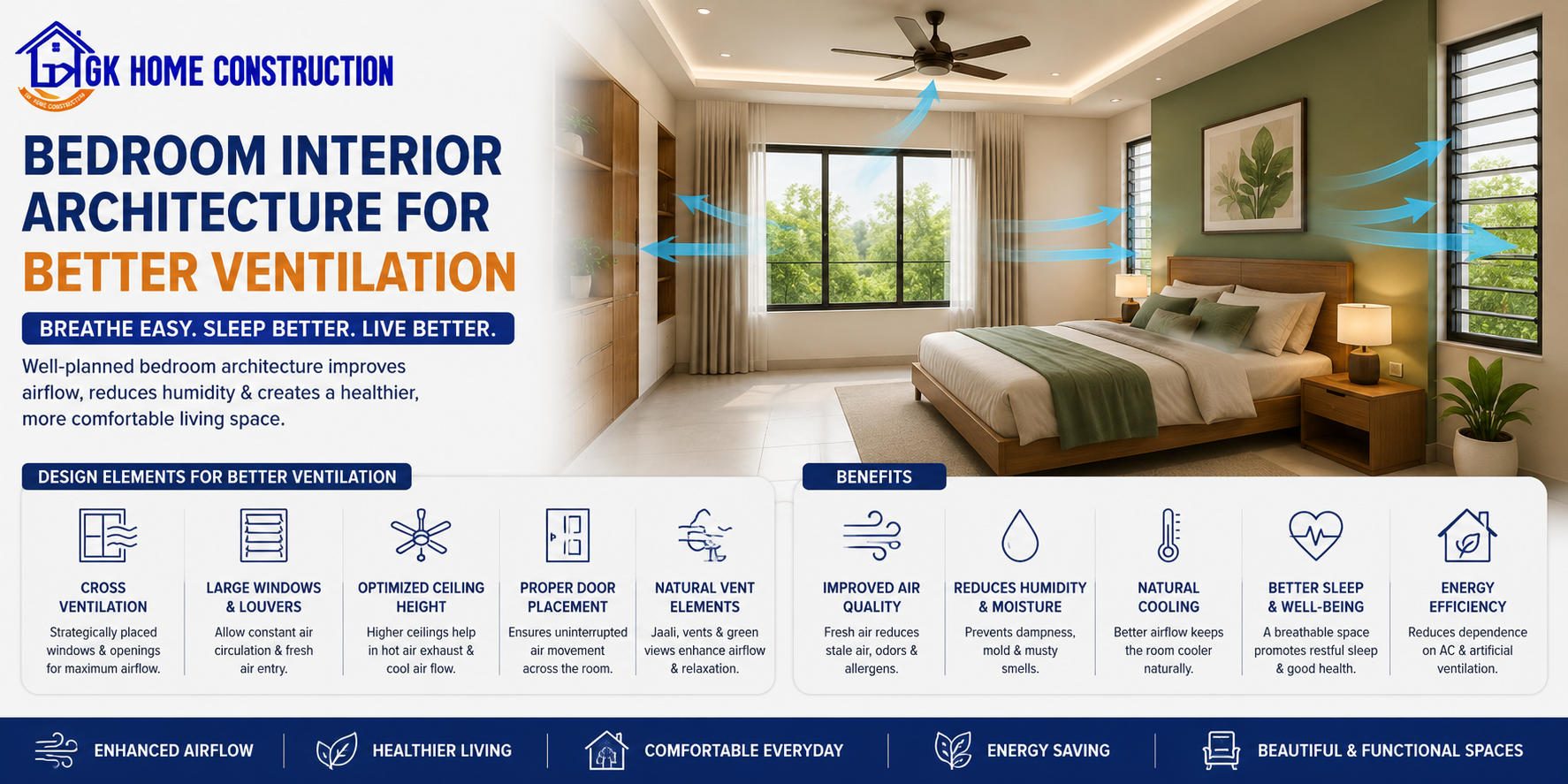
Bedroom Interior Architecture for Better Ventilation: Design Your Space to Breathe
When we think about bedroom design, most of us focus on aesthetics — the colours on the walls, the furniture arrangement, the lighting mood. But one of the most critical yet overlooked aspects of a well-designed bedroom is ventilation. Proper airflow in your sleeping space directly influences your health, sleep quality, and overall comfort. At GK Home Construction, we believe that a truly beautiful bedroom is one that not only looks stunning but also breathes well. Here is a deep dive into how bedroom interior architecture can be thoughtfully planned to ensure better ventilation.
Why Ventilation Matters More Than You Think
A bedroom is where you spend nearly one-third of your life. During sleep, your body releases carbon dioxide, moisture, and heat. Without adequate ventilation, these elements accumulate, leading to stuffiness, humidity, and poor air quality. Over time, poor ventilation causes dampness on walls, growth of mould and mildew, and triggers respiratory issues. Beyond health, a poorly ventilated bedroom also feels uncomfortable — you wake up feeling heavy, sweaty, or with a persistent headache. Good ventilation architecture ensures that fresh air circulates continuously, stale air exits, and the room maintains a natural thermal balance throughout the day and night.
Window Placement and Size: The Foundation of Natural Airflow
The single most powerful architectural decision you can make for bedroom ventilation is the strategic placement and sizing of windows. Cross-ventilation — the movement of air from one opening to another — is the gold standard in natural airflow design. To achieve this, windows should ideally be placed on opposite or adjacent walls rather than on a single wall. This creates a pressure difference that pulls fresh air in from one side and pushes stale air out from the other.
The size of the window also matters significantly. Larger windows with a lower sill height allow more air to enter at body level when you are lying or sitting down. Casement windows, which open outward on hinges, are particularly effective because they can be angled to catch prevailing winds and direct airflow into the room. Sliding windows, while common, are less efficient since only half the window area is ever open at one time. When designing or renovating your bedroom, discuss with your architect how to orient windows based on the direction of prevailing winds in your city or locality.
The Role of Ceiling Height in Air Circulation
Ceiling height is an architectural element that has a direct relationship with ventilation. Rooms with higher ceilings allow warm air — which naturally rises — to move upward and away from the living zone. This keeps the lower portion of the room cooler and more comfortable. Traditional Indian and colonial-era homes were built with high ceilings specifically for this reason, and modern architecture is revisiting this wisdom.
If you are building a new home or doing a complete renovation, consider a ceiling height of at least ten to eleven feet for your bedroom. You can complement this with a ceiling fan positioned at the right height — ideally seven to nine feet from the floor — to push the warm air back down during cooler months and create a cooling downdraft during summer. False ceilings, while popular for aesthetics and lighting, should be designed carefully so they do not significantly reduce the ceiling height and restrict airflow.
Door Positioning and Internal Air Paths
Ventilation is not just about what happens at the windows — it is also about how air moves through the interior of your home to reach the bedroom. The position of the bedroom door relative to the windows creates an internal air path. When the door and window are on opposite sides of the room, opening both creates a powerful cross-breeze even on days when the outdoor wind is calm.
Louvred doors or doors with ventilation grilles at the top and bottom are an excellent architectural feature for bedrooms, especially in warmer climates. They allow passive air movement even when the door is shut for privacy. Similarly, transom windows — small horizontal windows placed above door frames — are a classic yet highly effective way to keep air moving between rooms without compromising privacy or acoustics.
Choosing the Right Wall Finishes and Materials
The materials used in your bedroom walls and flooring also influence how the space breathes. Breathable wall finishes like lime plaster, clay paint, or textured mineral-based paints allow walls to absorb and release moisture naturally, preventing condensation and dampness. In contrast, synthetic paints and heavy vinyl wallpapers trap moisture within the wall, contributing to poor air quality over time.
Natural flooring options such as hardwood, terracotta tiles, or stone remain cooler underfoot and do not trap allergens the way wall-to-wall carpeting does. For the bedroom ceiling, avoiding excessive layers of gypsum board or foam insulation on the inner surface helps the room breathe better. Every material choice in a room's architecture either supports or hinders the natural movement of air and moisture.
Incorporating Vertical Gardens and Green Spaces
An increasingly popular and biophilic approach to bedroom ventilation is incorporating indoor plants or a small vertical garden near the bedroom window or balcony. Certain plants such as peace lilies, snake plants, and areca palms are known to improve indoor air quality by absorbing carbon dioxide and releasing oxygen. When placed near a window, these plants also benefit from natural airflow while contributing to a fresher indoor environment.
If your bedroom has access to a private balcony or a sit-out, designing a transition zone with potted greenery creates a natural air filter before the outdoor air enters your sleeping space. This is especially useful in urban environments where outdoor air carries dust, pollutants, and noise.
Smart Ventilation Meets Timeless Architecture
In today's construction landscape, smart ventilation systems such as Heat Recovery Ventilators (HRVs) and Energy Recovery Ventilators (ERVs) can be seamlessly integrated into the bedroom architecture during the construction phase. These systems exchange stale indoor air with fresh outdoor air without significant heat loss, maintaining comfort and air quality regardless of the season.
However, the most sustainable and cost-effective approach remains designing your bedroom around natural ventilation principles from the very beginning — before a single brick is laid or a single tile is fixed. At GK Home Construction, our approach combines timeless architectural wisdom with modern building techniques to create bedrooms that are not only beautiful but genuinely healthy spaces to live and rest in.
A well-ventilated bedroom is not a luxury — it is a fundamental requirement of good home design. Whether you are building your dream home from scratch or planning an interior renovation, prioritising ventilation in your bedroom architecture is an investment that pays off every single night.
Contact GK Home Construction
If you are planning to build or renovate a home and are searching for reliable house builders in Bangalore, GK Home Construction offers a straightforward and accountable construction process.
Their team provides clear guidance, realistic timelines, and quality-focused execution from planning to handover. Contact GK Home Construction to discuss your requirements and take the next step toward building a home with confidence.
Phone:+91 9538999535
Website:https://gkhomeconstruction.com/
Location:340, GPR Royale Layout, Huskur Road, Electronic City PH 2, Near fruit market, Bengaluru, Karnataka 560100.