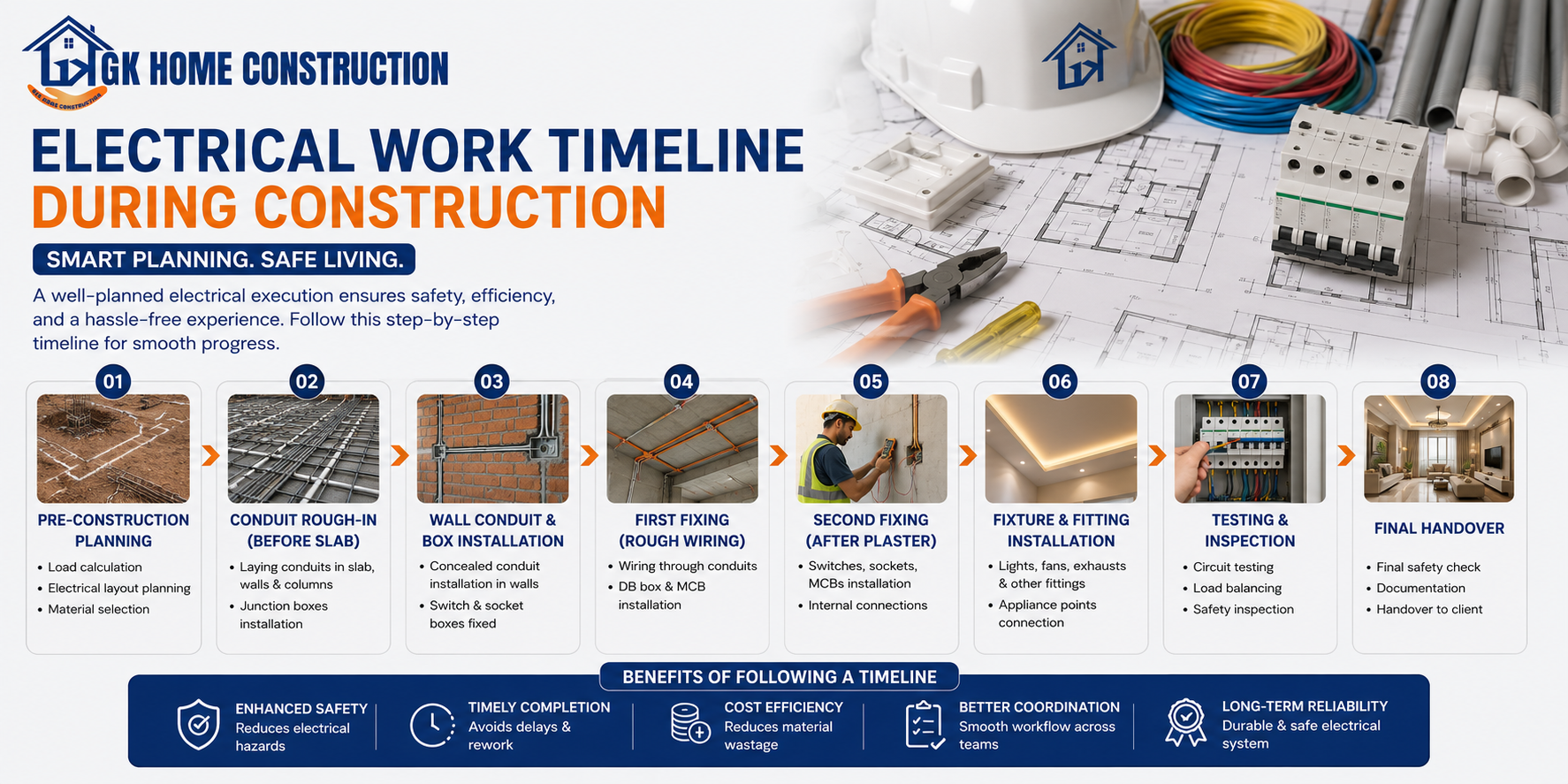
Electrical Work Timeline During Construction: A Complete Guide by GK Home Construction
Building a new home is an exciting journey, but it comes with a series of carefully planned stages that must follow a precise order. Among all the critical work that goes into constructing a home, electrical work holds a special place. It is not just about switching on the lights — it is about powering your entire lifestyle safely and efficiently. At GK Home Construction, we believe that understanding the electrical work timeline during construction helps homeowners make better decisions, avoid costly reworks, and ensure a smooth building process from start to finish. Here is a detailed breakdown of how electrical work progresses through each phase of construction.
Why Electrical Planning Begins Before Construction Starts
Most homeowners assume that electrical work begins once the walls go up, but the reality is that proper electrical planning starts at the design stage itself. Before a single brick is laid, the electrical engineer and the architect collaborate to develop a detailed electrical layout. This layout includes the positioning of the main distribution board, the number of circuits required, the load calculations for each room, and the placement of switches, sockets, lights, fans, and heavy appliances like air conditioners and geysers.
At GK Home Construction, we integrate electrical planning into the architectural blueprint from day one. This prevents expensive structural changes later and ensures that conduits and wiring pathways are embedded properly within the building framework. A well-thought-out electrical plan is the foundation of a safe and functional home.
Phase 1: Foundation and Underground Electrical Work
Once construction begins, the first electrical task happens underground. During the foundation stage, electricians lay underground conduit pipes that carry the main power supply from the electricity meter to the building. These conduit pipes are embedded beneath the flooring and plinth before concrete is poured, making it impossible to add them later without breaking the floor.
This phase also involves setting up the temporary electrical connection needed to power construction equipment, mixers, and lighting on the worksite. The temporary connection is managed carefully and disconnected once permanent wiring is commissioned. At GK Home Construction, we ensure that underground conduit work is inspected for proper depth, waterproofing, and alignment before concreting begins, as this is one of the most overlooked yet critical stages of the entire project.
Phase 2: Rough-In Electrical Work During Structure Construction
As the walls and slabs of the building take shape, the rough-in electrical phase begins. This is one of the busiest periods for electricians on any construction site. During this phase, conduit pipes are embedded inside the brick walls and concrete slabs before plastering begins. These conduit pipes act as protected channels through which the electrical wires will later be pulled.
Junction boxes, switch board frames, and outlet boxes are fixed into the walls at precisely measured heights according to the electrical layout. The conduit network runs from the main distribution board location to every room, connecting all points where switches, sockets, lights, fans, and appliances will eventually be installed. At this stage, no actual wiring is pulled — only the empty conduit infrastructure is set in place.
This phase demands absolute accuracy. Any mistake in conduit alignment or box positioning will require chiseling out plastered walls later, leading to additional cost and time loss. The GK Home Construction team conducts a thorough inspection of the rough-in work before authorizing the plastering team to proceed, ensuring every conduit run is correct and every box is level and flush with the planned wall surface.
Phase 3: Plastering, Finishing, and Wiring Pull-Through
After the plastering and wall finishing work is completed, the electricians return to pull the actual electrical wires through the previously installed conduits. This process is called wire pulling or wire threading. The electricians use a steel fish tape or pull wire to thread insulated copper wires through the conduit system from the main distribution board to each outlet, switch, and light point.
Different circuits are wired separately during this phase — the lighting circuit, the power socket circuit, the air conditioning circuit, and the dedicated circuits for heavy appliances are all wired as independent loops with their own protective breakers. Using dedicated circuits for high-load appliances is a safety standard that GK Home Construction strictly follows, as it prevents overloading and reduces the risk of electrical fires.
The wires at each termination point are left with enough extra length to allow neat and proper connection to switches, sockets, and fixtures during the final fit-out stage. Every wire is labelled clearly to identify which circuit it belongs to, making the connection process organized and error-free.
Phase 4: Main Distribution Board Installation and Circuit Testing
Once all the wiring is pulled through and the internal finishes are nearing completion, the main electrical distribution board — commonly called the DB box or breaker panel — is installed and wired. The distribution board is the control center of the entire electrical system. It houses the main switch, individual circuit breakers for each circuit, and safety devices such as residual current devices and earth leakage protection units.
Each circuit breaker is connected to its respective circuit, and the entire system undergoes a thorough continuity test and insulation resistance test to verify that there are no short circuits, open circuits, or grounding faults. At GK Home Construction, we conduct these tests in collaboration with a certified electrical contractor, ensuring that the installation fully complies with the National Electrical Code standards applicable in India.
Phase 5: Final Fit-Out and Commissioning
The last stage of electrical work coincides with the final finishing of the home. This is when switches, sockets, light fixtures, fans, exhaust units, and appliance connections are installed and connected. The switchboards are fitted with modular plates, the DB box is labeled, and all circuits are powered on and tested one by one for full functionality.
The GK Home Construction team also ensures that the external electricity meter connection is established with the local electricity distribution company, and the permanent service connection is commissioned. A final inspection is carried out to verify that every electrical point functions correctly, every safety device trips as required, and the home is ready for safe occupancy.
Final Thoughts
The electrical work timeline during construction is a layered and sequential process that spans from the earliest days of the project to its final completion. Each phase builds on the previous one, and skipping or rushing any stage creates long-term safety risks and expensive repairs. At GK Home Construction, we treat electrical work as one of the most important investments in your home — because when it is done right, it works silently and safely for decades. If you are planning to build your dream home, our experienced team is here to guide you through every step of the process.
Contact GK Home Construction
If you are planning to build or renovate a home and are searching for reliable house builders in Bangalore, GK Home Construction offers a straightforward and accountable construction process. Their team provides clear guidance, realistic timelines, and quality-focused execution from planning to handover. Contact GK Home Construction to discuss your requirements and take the next step toward building a home with confidence.
Phone:+91 9538999535Website:https://gkhomeconstruction.com/Location:340, GPR Royale Layout, Huskur Road, Electronic City PH 2, Near fruit market, Bengaluru, Karnataka 560100.