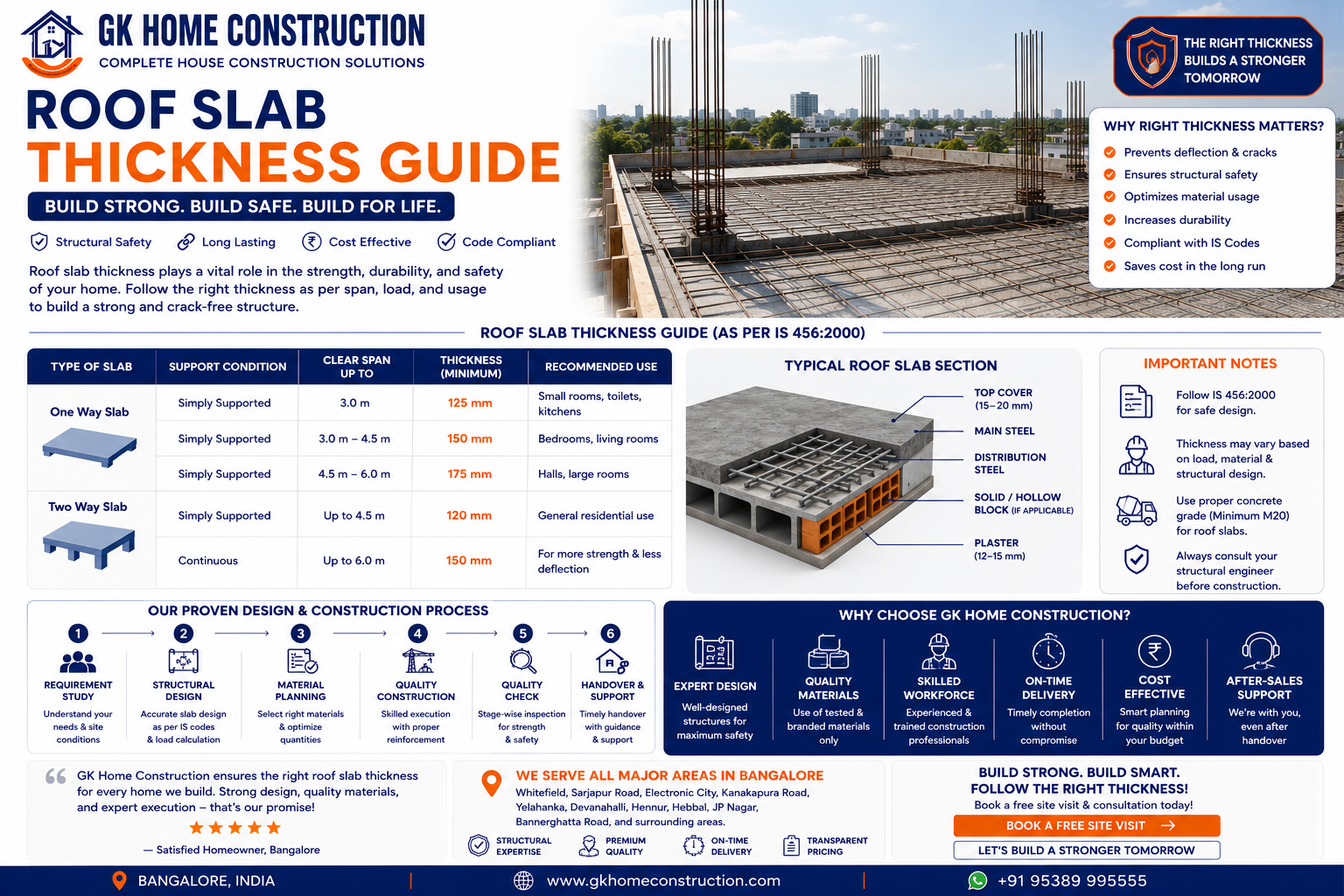

What Is M20 Concrete and Why Does the Grade Matter for Your Home's Slab?
When planning to build a home, most homeowners focus on visible aspects such as the architectural design, flooring, paint, kitchen finishes, and interiors. However, the real strength of a house lies in what cannot be seen after construction is complete—the structural framework. Among the many structural elements, the roof slab plays one of the most important roles in ensuring the safety, durability, and lifespan of your home. One of the key factors that determines the quality of a slab is the grade of concrete used during construction. While terms like M20, M25, or M30 may sound technical, understanding what they mean can help homeowners make better decisions and avoid costly mistakes. If you are planning to build your dream home in Bangalore, knowing why M20 concrete is widely used for residential slabs is essential.
Understanding What M20 Concrete Means
Concrete grades indicate the compressive strength achieved by concrete after 28 days of proper curing. The letter "M" stands for Mix, while the number represents the concrete's characteristic compressive strength measured in megapascals (MPa). Therefore, M20 concrete is designed to achieve a 28-day compressive strength of 20 MPa under standard curing conditions.
In simple terms, M20 concrete is strong enough to withstand the loads typically experienced in residential buildings. It provides a balanced combination of strength, durability, and affordability, making it one of the most commonly used concrete grades for individual homes across India. While homeowners may not directly see this strength after the slab is completed, it forms the backbone of the entire building structure.
Why the Roof Slab Is One of the Most Critical Parts of Your Home
The roof slab is more than just the surface above your head. It carries the weight of walls, furniture, occupants, water tanks, solar panels, and sometimes even future floors if the home is designed for expansion. A poorly constructed slab can develop cracks, sagging, water leakage, or even structural weaknesses over time.
Since the slab becomes a permanent structural element, there is very little opportunity to correct mistakes after construction. This is why selecting the correct concrete grade and ensuring proper execution during slab casting are absolutely essential. A high-quality slab contributes significantly to the safety, comfort, and longevity of your home.
Why M20 Concrete Is Commonly Used for Residential Slabs
For most independent residential homes, M20 concrete offers the ideal balance between structural performance and construction cost. It provides sufficient compressive strength to safely support the loads typically found in one- or two-storey houses while maintaining good workability during construction.
Builders and structural engineers often recommend M20 concrete because it delivers reliable performance when mixed correctly, placed properly, vibrated thoroughly, and cured for the required duration. It also performs well under varying weather conditions, making it suitable for Bangalore's climate.
However, it is important to understand that using M20 concrete alone does not guarantee a strong slab. The quality of cement, aggregates, water, reinforcement steel, workmanship, and curing practices all work together to achieve the desired strength.
Why Concrete Grade Matters More Than Most Homeowners Realize
Many homeowners assume that all concrete is the same. Unfortunately, this misconception can lead to poor construction quality. The concrete grade directly affects how much load the structure can safely bear throughout its life.
If a lower-grade concrete is used where M20 is required, the slab may not develop adequate strength. Over time, this can result in visible cracks, increased deflection, water seepage, reinforcement corrosion, and expensive repairs. In difficult situations, structural safety may also be compromised.
On the other hand, selecting the appropriate concrete grade ensures that the slab remains stable, durable, and capable of handling daily loads for decades. The right concrete grade also improves resistance against environmental factors such as moisture, temperature changes, and natural ageing.
The Importance of Proper Concrete Mixing and Quality Control
Even if the design specifies M20 concrete, poor mixing practices can significantly reduce its strength. Maintaining the correct water-cement ratio is one of the most important aspects of producing quality concrete. Excess water may make concrete easier to pour, but it also weakens the final structure by increasing porosity.
Similarly, using poor-quality aggregates or inconsistent batching can affect the overall strength of the slab. Professional construction companies follow strict quality control procedures, ensuring that every ingredient is measured accurately before mixing.
Many reputed builders also perform slump tests before pouring concrete to check workability and ensure consistency. During larger projects, concrete cube tests are conducted to verify that the required compressive strength is achieved after curing.
Proper Curing Is Just as Important as the Concrete Grade
One of the biggest mistakes seen in residential construction is inadequate curing. Many homeowners believe that once the slab has been poured, the work is complete. In reality, curing is one of the most critical stages in achieving the designed concrete strength.
Concrete requires sufficient moisture for the cement hydration process to continue. Without proper curing, concrete may lose moisture too quickly, leading to surface cracks, reduced strength, and lower durability. For M20 concrete, curing should generally continue for at least 14 days, while many experts recommend 21 to 28 days for even better long-term performance.
Proper curing allows the slab to gain its intended strength gradually, ensuring that it performs as designed throughout the building's lifespan.
Is Higher Concrete Grade Always Better?
A common question homeowners ask is whether they should simply choose M25 or M30 concrete instead of M20 for better safety. While higher grades do provide greater compressive strength, they are not automatically the best choice for every residential project.
Every building is structurally designed based on factors such as soil conditions, number of floors, load calculations, and reinforcement design. Using unnecessarily higher-grade concrete without corresponding structural requirements may increase construction costs without providing meaningful benefits.
The ideal approach is to follow the recommendations of a qualified structural engineer who determines the most suitable concrete grade based on the building design. For many standard residential homes, M20 concrete remains the recommended and economical choice.
How Professional Construction Companies Ensure Strong Slabs
Experienced home construction companies understand that slab quality depends on much more than simply ordering concrete. They carefully supervise reinforcement placement, shuttering quality, concrete batching, vibration, finishing, curing, and quality inspections throughout the slab casting process.
At GK Home Construction, every stage of structural construction is carried out with a strong focus on engineering standards, quality materials, and skilled workmanship. From selecting the appropriate concrete grade to monitoring curing procedures, every detail is managed to ensure that homeowners receive a structurally sound home that will stand strong for generations.
This systematic approach minimizes construction defects, improves durability, and provides homeowners with confidence that their investment is built on a solid foundation.
Final Thoughts
Building a home is one of the most significant investments you will ever make, and every structural decision has long-term consequences. While decorative finishes can always be upgraded later, the roof slab remains a permanent structural component that must be built correctly from the very beginning.
Understanding what M20 concrete is and why its grade matters empowers homeowners to ask the right questions during construction. A properly designed and executed M20 concrete slab offers the strength, durability, and reliability needed for most residential homes, provided it is supported by quality materials, accurate mixing, professional workmanship, and proper curing.
When choosing a construction partner, look beyond attractive designs and competitive pricing. Select a builder who prioritizes engineering excellence, follows quality control procedures, and uses the right concrete grade for every structural element. After all, the true strength of your dream home begins with the concrete that holds it together.