Electrical Planning for Modular Kitchens: Everything You Need to Know Before You Build
When most homeowners think about designing a modular kitchen, their minds immediately go to cabinet finishes, countertop materials, or the perfect backsplash tile. Electrical planning, however, is the one element that quietly determines whether your dream kitchen will function smoothly for decades — or become a source of daily frustration. Getting the electrical layout right from the very beginning is not just a technical necessity; it is a long-term investment in the comfort and safety of your home.
At GK Home Construction, we have seen countless kitchen renovation projects where electrical planning was treated as an afterthought. The result? Appliances plugged into extension cords, insufficient lighting over work areas, and overloaded circuits that trip the breaker every time you run the microwave and the mixer simultaneously. This guide is designed to help you understand why electrical planning deserves to be the very first conversation in your modular kitchen journey.
Why Electrical Planning Must Come First
A modular kitchen is built around precision. Every cabinet, every shelf, and every appliance has a fixed position. Once the installation is complete, repositioning an outlet or adding a new circuit means breaking walls, disrupting finished surfaces, and spending money you did not plan to spend. This is why electrical rough-in work — the laying of conduits, wiring, and circuit lines — must happen before any modular unit is fixed in place.
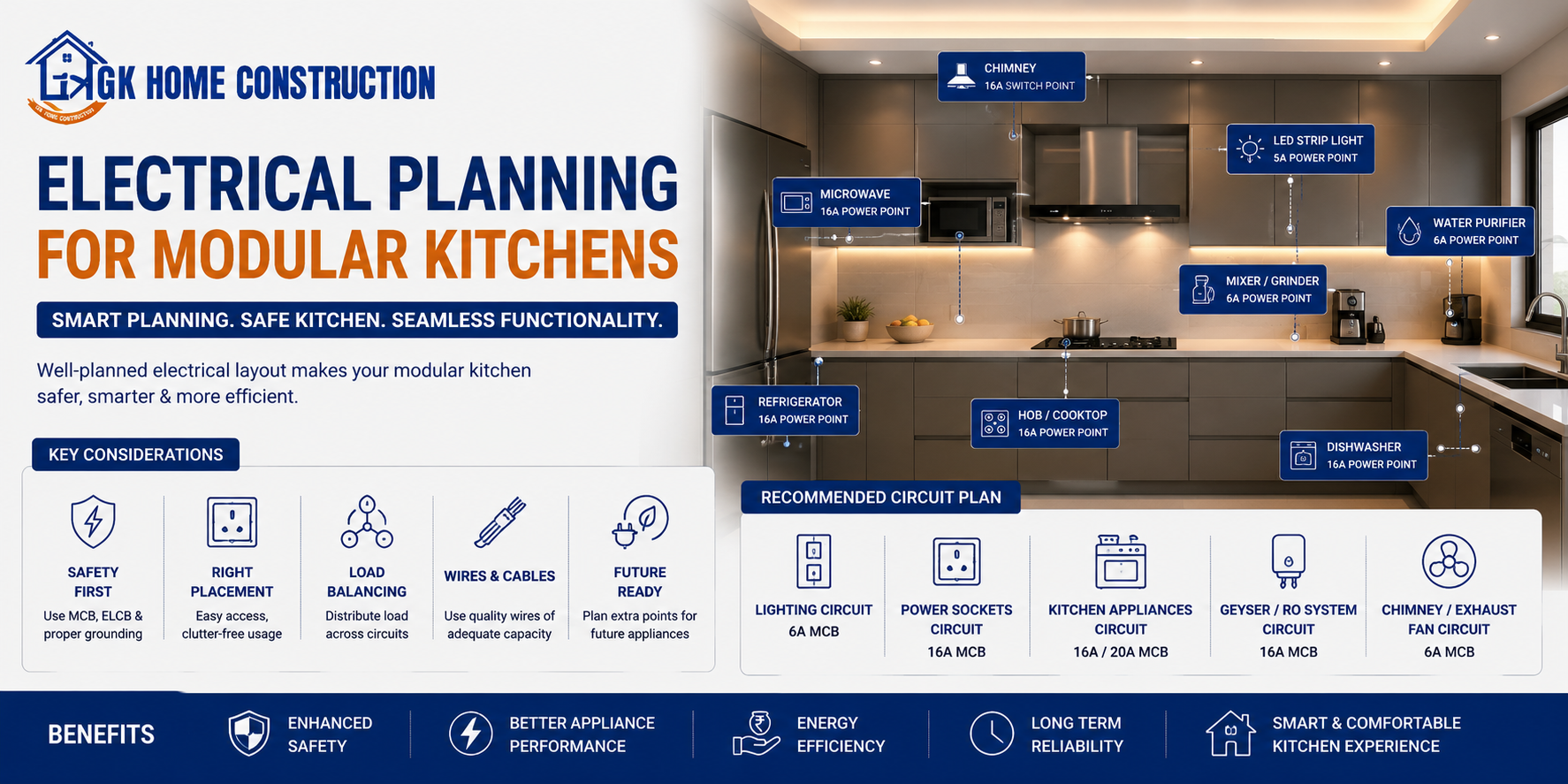
The electrical plan for your kitchen needs to be coordinated directly with your kitchen layout plan. Your electrician and your kitchen designer should ideally be working from the same drawing. The position of your hob, your built-in oven, your refrigerator, your dishwasher, and your microwave all dictate where power points must be placed, what load capacity each circuit must carry, and how many independent circuits the kitchen will require.
Understanding Kitchen Load Requirements
A modern modular kitchen is home to some of the most power-hungry appliances in your entire house. A built-in oven alone can draw anywhere between 2,000 to 3,500 watts. Add a microwave, a dishwasher, a chimney, a refrigerator, a mixer grinder, and a coffee machine, and you are looking at a kitchen that can easily demand 8,000 to 12,000 watts during peak usage.
This is why kitchens must never run on a single shared circuit. Professional electrical planning divides the kitchen into multiple dedicated circuits. Heavy appliances like the oven, hob, and dishwasher should each have their own independent circuit with a dedicated MCB (Miniature Circuit Breaker) in your distribution board. Smaller countertop appliances like the toaster, mixer, and kettle can share a separate countertop circuit, but this too should be independent from the lighting and refrigerator lines.
Proper load calculation done upfront ensures you never face tripped breakers, voltage fluctuations, or the fire hazards that come from overloaded wiring.
Outlet Placement: Thinking Through Every Workflow
One of the most practical aspects of electrical planning is determining exactly where power outlets should be placed. The goal is to make every appliance accessible without the need for extension cords, while keeping outlets hidden from plain view so they do not interrupt the clean aesthetic of your modular kitchen.
Countertop outlets are ideally positioned just above the work surface height, behind the upper cabinet line, or inside a dedicated modular socket unit built flush into the cabinet design. For the cooking zone, you will need dedicated points for the chimney and hob ignition. For the washing zone, a separate point for the dishwasher must be positioned inside the under-sink cabinet, away from potential water contact.
If you are incorporating a breakfast counter or kitchen island into your modular design, plan outlet points on the island column itself. Many homeowners overlook this and end up unable to use their island for anything that requires power. Similarly, if you plan to mount a television or audio system in the kitchen, the electrical and data points for these must be planned before the wall units are installed.
Kitchen Lighting: Layers That Serve a Purpose
Lighting in a modular kitchen goes far beyond a single ceiling fixture. Professional kitchen electrical planning incorporates a layered lighting approach that serves both function and ambiance. The three layers are task lighting, ambient lighting, and accent lighting — and each requires independent wiring and switching.
Task lighting refers to the under-cabinet LED strips or downlights positioned directly over the countertop work area. These are critical for safe food preparation, especially in kitchens where overhead lighting casts shadows on the work surface. The wiring for under-cabinet lights must run inside the wall behind the upper units before installation, with switch points placed at a convenient location outside the cooking zone.
Ambient lighting covers the general illumination of the kitchen and typically comes from ceiling-mounted fixtures or recessed downlights. Accent lighting is used to highlight open shelves, glass-front cabinets, or the toe-kick area beneath base units. All three circuits should ideally be on dimmers so you can control the mood and energy consumption based on the time of day and your activity.
Earthing, Safety Switches, and Compliance
A kitchen is a wet, high-usage environment, which makes proper earthing and safety measures non-negotiable. Every outlet in the kitchen must be properly earthed. Outlets near the sink or dishwasher should be protected by a Residual Current Device (RCD) or Earth Leakage Circuit Breaker (ELCB), which cuts power instantly if a leakage is detected — protecting you from electric shock.
All kitchen electrical work must comply with the National Building Code and local municipal electrical regulations. Using certified wires, ISI-marked switches and outlets, and licensed electricians is not optional — it is a safety and legal requirement. At GK Home Construction, every project we undertake follows a strict compliance checklist to ensure that your kitchen is not just beautiful, but safe for every member of your family.
The Right Time to Plan Is Now
Electrical planning for a modular kitchen is not a task that can be fixed later. It is the invisible foundation beneath every polished cabinet and gleaming countertop. When you invest the time and thought into a proper electrical layout before construction begins, you are creating a kitchen that is safe, functional, and built to support your life exactly as you live it.
If you are planning a modular kitchen and would like expert guidance on getting the electrical and design layout right from day one, GK Home Construction is here to help. Reach out to our team and let us build something exceptional together.