Plumbing Guidelines as Per Indian Standards: What Every Homeowner Must Know
Building a home is one of the most significant investments you will ever make, and within that investment, plumbing is one of the most critical yet often overlooked aspects. Poor plumbing decisions made during construction can lead to water leakages, contamination, structural damage, and expensive repairs for decades to come. In India, the Bureau of Indian Standards (BIS) has established a comprehensive set of guidelines to ensure that plumbing systems across residential and commercial buildings are safe, durable, and efficient. At GK Home Construction, we follow these standards strictly on every project we undertake. This blog walks you through the essential plumbing guidelines as per Indian Standards so that you, as a homeowner, can make informed decisions.
Understanding the Bureau of Indian Standards (BIS) for Plumbing
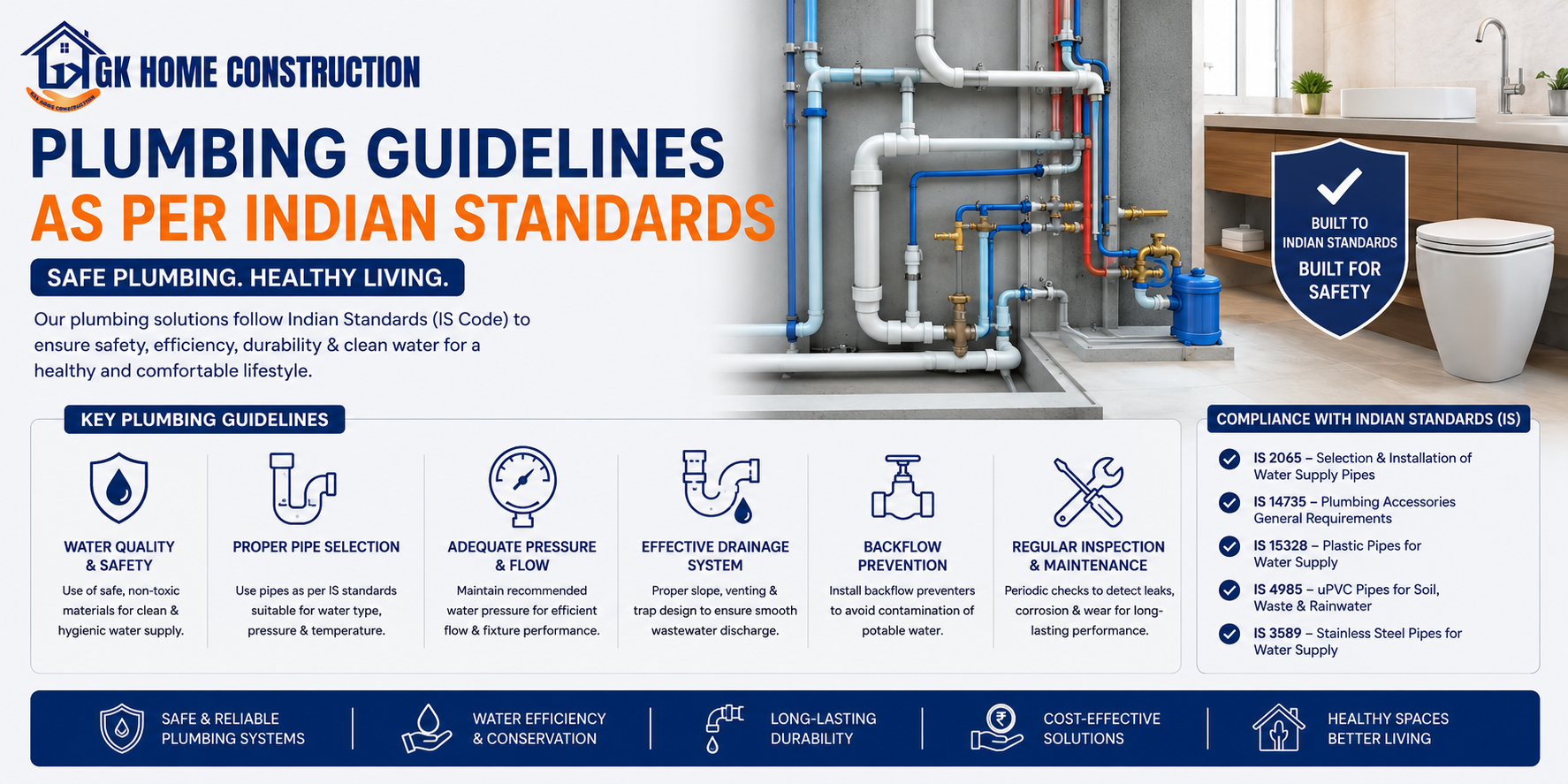
The Bureau of Indian Standards is the national body responsible for formulating quality and safety benchmarks across industries in India, including construction and plumbing. The primary code governing plumbing in India is the National Building Code of India (NBC) 2016, Part 9, Section 2, which deals entirely with plumbing services. Alongside this, IS codes such as IS 1239 (for steel pipes), IS 4984 (for HDPE pipes), IS 15328 (for CPVC pipes), and IS 12235 (for UPVC pipes) are widely referenced. These codes define specifications for pipe materials, pipe sizing, joint types, installation practices, and water supply pressure norms that every builder must adhere to.
Water Supply System: Pipes, Pressure, and Material Selection
One of the first decisions in any plumbing layout is the choice of pipe material, and Indian Standards provide clear direction on this. For internal water supply lines, CPVC (Chlorinated Polyvinyl Chloride) pipes conforming to IS 15328 are highly recommended because they handle both hot and cold water efficiently and resist corrosion. For underground water supply, HDPE pipes as per IS 4984 are preferred due to their flexibility, chemical resistance, and long service life. GI (Galvanized Iron) pipes conforming to IS 1239 are still in use, particularly in older construction, but are gradually being replaced by modern alternatives.
As per NBC 2016 guidelines, the minimum water pressure at any outlet point in a residential building should be 0.7 kg/cm², and the maximum should not exceed 5.5 kg/cm². Maintaining this pressure range ensures that fixtures function correctly without causing pipe stress or leakage over time. Builders are required to install pressure-reducing valves (PRVs) wherever the municipal supply pressure exceeds permissible limits.
Drainage and Waste Water System Standards
The drainage system is as important as the water supply system, and Indian Standards are very specific about how it must be designed and installed. As per NBC guidelines, every residential unit must have a two-pipe system, meaning soil pipes (carrying human waste) and waste pipes (carrying kitchen and bathroom grey water) must be kept separate up to a certain level before joining the main drain. This separation prevents cross-contamination and keeps the drainage system hygienic.
The minimum diameter for a soil pipe in Indian residential construction is 100 mm (4 inches), while waste pipes from wash basins and kitchen sinks must be a minimum of 32 mm to 50 mm in diameter. All drainage pipes must be laid with a proper slope — typically 1 in 40 to 1 in 110 for horizontal runs — to ensure self-cleansing flow without blockages. Every sanitary fitting must also be connected through a properly designed P-trap or S-trap with a water seal of at least 50 mm to prevent foul gases from entering the living space.
Sanitary Fixtures and Fitting Standards
Indian Standards specify minimum quality requirements for all sanitary fixtures used in homes. Wash basins, water closets (WCs), bathtubs, and kitchen sinks must conform to relevant IS codes — for example, IS 2556 covers vitreous china sanitary appliances. When installing WCs, the flush tank or flush valve must be designed to consume no more than 6 litres per flush for dual-flush systems, aligning with the growing emphasis on water conservation in Indian construction norms.
Taps, faucets, and valves must comply with IS 8931 for pillar taps and IS 9845 for stop valves to ensure they can withstand operating pressures without failure. It is also mandatory to provide an isolation valve near every major fixture so that repairs can be carried out without shutting down the entire water supply of the building.
Hot Water Plumbing and Safety Norms
In modern Indian homes, hot water systems — whether solar water heaters, electric geysers, or centralized systems — are now a standard requirement. Indian Standards specify that hot water pipes must be insulated to prevent heat loss, and all hot water lines must be clearly distinguishable from cold water lines, typically through color coding or labeling. The temperature of hot water at the point of use should not exceed 45°C to prevent scalding, especially in homes with elderly residents and children.
Expansion joints and pressure relief valves are mandatory on all hot water storage systems as per IS codes to handle thermal expansion and prevent pressure build-up, which can otherwise cause catastrophic pipe bursts.
Water Conservation and Rainwater Harvesting Compliance
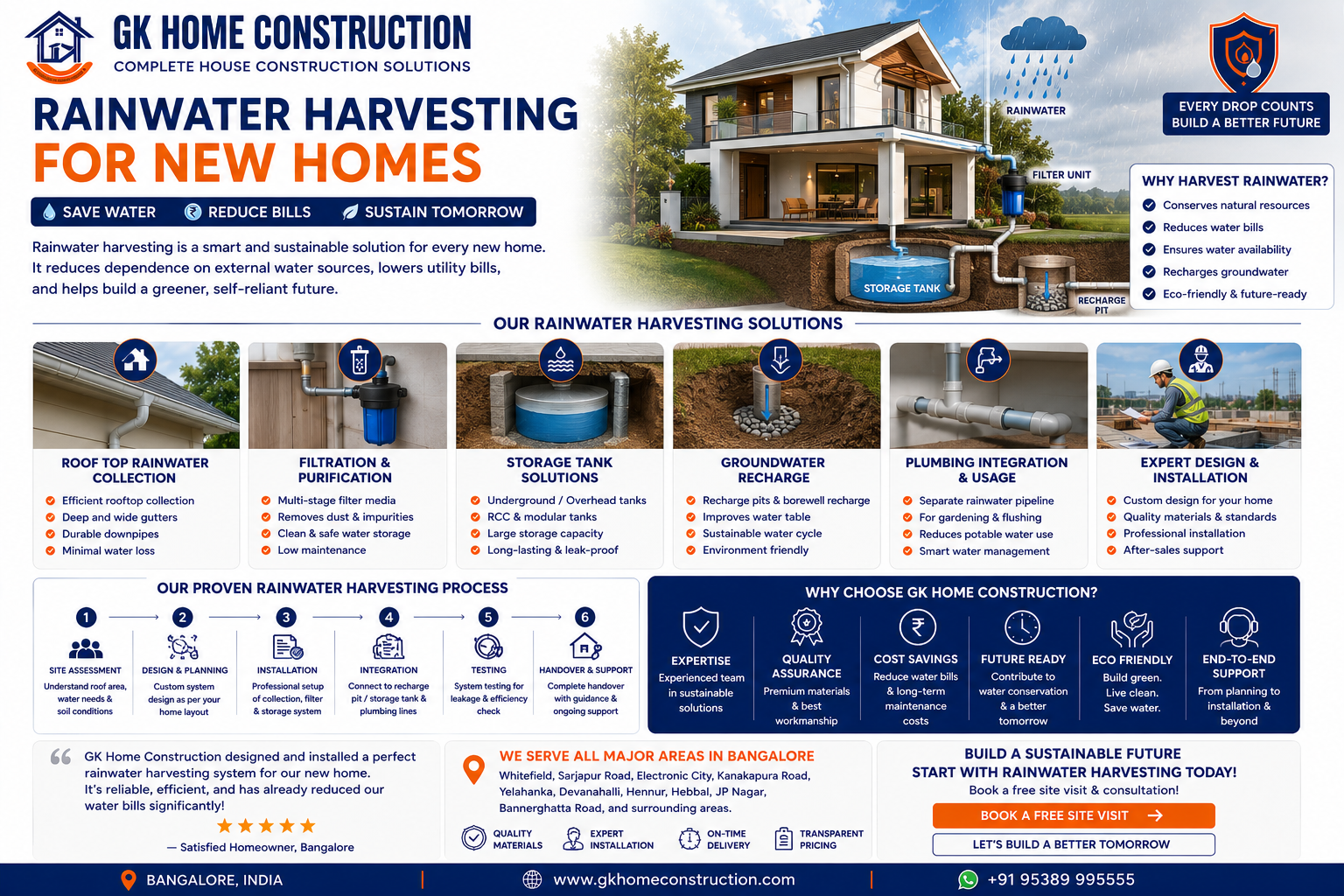
India's building regulations, especially in urban areas, now make it increasingly mandatory to incorporate rainwater harvesting systems into new constructions. As per guidelines from the Central Ground Water Board and NBC 2016, buildings above a certain plot size must include a rainwater collection and recharge system. Plumbers and builders must design these systems in a way that rooftop runoff is channeled through filters and directed either to underground recharge pits or storage tanks for reuse in toilet flushing and gardening.
Why Following Indian Plumbing Standards Protects Your Investment
Adhering to plumbing standards is not just a legal obligation — it is a financial and health safeguard. Substandard plumbing leads to recurring leakages, mold growth within walls, contaminated drinking water, and expensive rework costs. At GK Home Construction, every plumbing installation is carried out by trained professionals using only BIS-certified materials, ensuring that your home's plumbing system is built to last for generations. Whether you are constructing a new home or renovating an existing one, understanding and insisting on Indian Standard-compliant plumbing is the smartest decision you can make as a homeowner.
Contact GK Home Construction
If you are planning to build or renovate a home and are searching for reliable house builders in Bangalore, GK Home Construction offers a straightforward and accountable construction process.
Their team provides clear guidance, realistic timelines, and quality-focused execution from planning to handover. Contact GK Home Construction to discuss your requirements and take the next step toward building a home with confidence.
Phone:+91 9538999535
Website:https://gkhomeconstruction.com/
Location:340, GPR Royale Layout, Huskur Road, Electronic City PH 2, Near fruit market, Bengaluru, Karnataka 560100.