Carpenter Work Timeline in House Construction: A Complete Guide
Building a home is one of the most significant investments a person makes in their lifetime, and among all the trades involved, carpentry plays a central role in shaping the structure, functionality, and beauty of the finished space. This central role is explored further in our guide on the role of carpentry in house construction. From the very first beam that goes up to the final cabinet installed in your kitchen, carpenter work runs through nearly every phase of house construction. Understanding this timeline not only helps homeowners plan their budgets wisely but also ensures the project moves forward without unnecessary delays or rework.
Phase 1: Structural Framing — The Backbone of Your Home
The first major carpentry phase begins immediately after the foundation is laid and cured. This is structural framing, and it is arguably the most critical stage of the entire construction process. During this phase, carpenters erect the skeleton of the house — the floor joists, wall frames, roof rafters, and stud partitions that define every room, corridor, and opening in your home.
Depending on the size and complexity of the house, structural framing typically takes anywhere from two to four weeks for a standard residential project. Larger or custom homes with intricate rooflines, multiple floors, or premium wood structures can extend this phase to six weeks or more. The quality of work done here directly influences the stability and longevity of the entire building. Any misalignment at this stage can cause doors and windows to jam, floors to slope, or walls to develop cracks years down the line. This is why hiring experienced, skilled carpenters for framing is non-negotiable.
Phase 2: Roof Carpentry and Sheathing
Once the wall frames are standing and verified plumb and square, the focus shifts upward to the roof. Roof carpentry involves installing rafters or engineered roof trusses, ridge beams, and hip and valley structures that define your roof's shape. After the structural roof skeleton is complete, sheathing boards or plywood panels are nailed across the rafters to create a solid surface for roofing materials like tiles or sheets to be laid.
This phase usually runs concurrently with the tail end of wall framing and typically takes one to two weeks. Weather conditions play a significant role here — strong winds or heavy rain can halt roof work for safety reasons. At GK Home Construction, our carpenters are trained to work efficiently within weather windows to prevent delays from pushing the rest of the construction schedule.
Phase 3: Door and Window Frames
With the structure enclosed and the roof covered, the next carpentry milestone is the installation of door and window frames. These openings need to be precisely cut, framed, and reinforced so that the doors and windows fit perfectly, open smoothly, and maintain an airtight seal. Even a few millimeters of inaccuracy can lead to gaps, drafts, and water seepage over time.
This phase generally takes about one week for a standard three-bedroom home, though homes with larger numbers of openings or custom arched or oversized windows will naturally require more time. At this stage, close coordination between the carpenter and the masonry team is essential to ensure the frames integrate well with the surrounding walls.
Phase 4: Flooring Carpentry
After the civil work — including plastering and major electrical and plumbing rough-ins — is substantially complete, carpentry returns to the interior for flooring work. In homes that opt for hardwood flooring, parquet, laminate wood planks, or wooden subfloor systems, skilled carpenters take over the floor installation process. They ensure proper leveling, clean edge cuts at walls, and tight joint fitting between planks to give the floor a professional, gap-free appearance.
Flooring carpentry typically takes one to two weeks depending on the square footage and the type of wood or engineered material chosen. Hardwood flooring, in particular, requires acclimation time before installation — the wood planks need to sit in the room for a few days to adjust to the ambient humidity and temperature before they are fixed, preventing future warping or buckling. Choosing the right material at this stage matters — see our guide on types of wood for house construction to understand which options handle humidity and warping best.
Phase 5: Interior Woodwork — Staircase, Paneling, and False Ceilings
This is the phase where the home begins to transform from a bare construction shell into a warm, livable space. Interior woodwork covers a broad range of tasks — building staircases with wooden treads and railings, installing wall paneling, constructing wooden false ceilings, fitting skirting boards, and creating decorative trims around doors, windows, and corners.
Among these, the staircase is the most time-intensive component, often requiring one to two weeks of dedicated carpenter time depending on the design complexity. Decorative paneling and false ceiling frameworks add another one to three weeks depending on the scale of the interiors. At GK Home Construction, we design this phase meticulously because the interior woodwork defines the visual character and premium feel of your home.
Phase 6: Furniture Carpentry — Wardrobes, Cabinets, and Kitchen Units
The final and often most visible phase of carpenter work in house construction is the fabrication and installation of built-in furniture. This includes bedroom wardrobes, kitchen cabinets and countertop supports, bathroom vanity units, TV unit frameworks, study shelving, and utility storage systems. This work is typically done after painting is complete to avoid staining the wood finish.
This phase is the longest in terms of elapsed time because it involves custom measurement, off-site fabrication, and precise on-site installation. For a full home, built-in furniture carpentry can span three to six weeks. The quality of materials chosen — from plywood grades to laminates and hinges — and the craftsmanship applied here will determine how your furniture holds up through daily use over the coming decades. For a closer look at these material options, see our guide on kitchen carpentry materials.
Managing the Carpenter Work Timeline Effectively
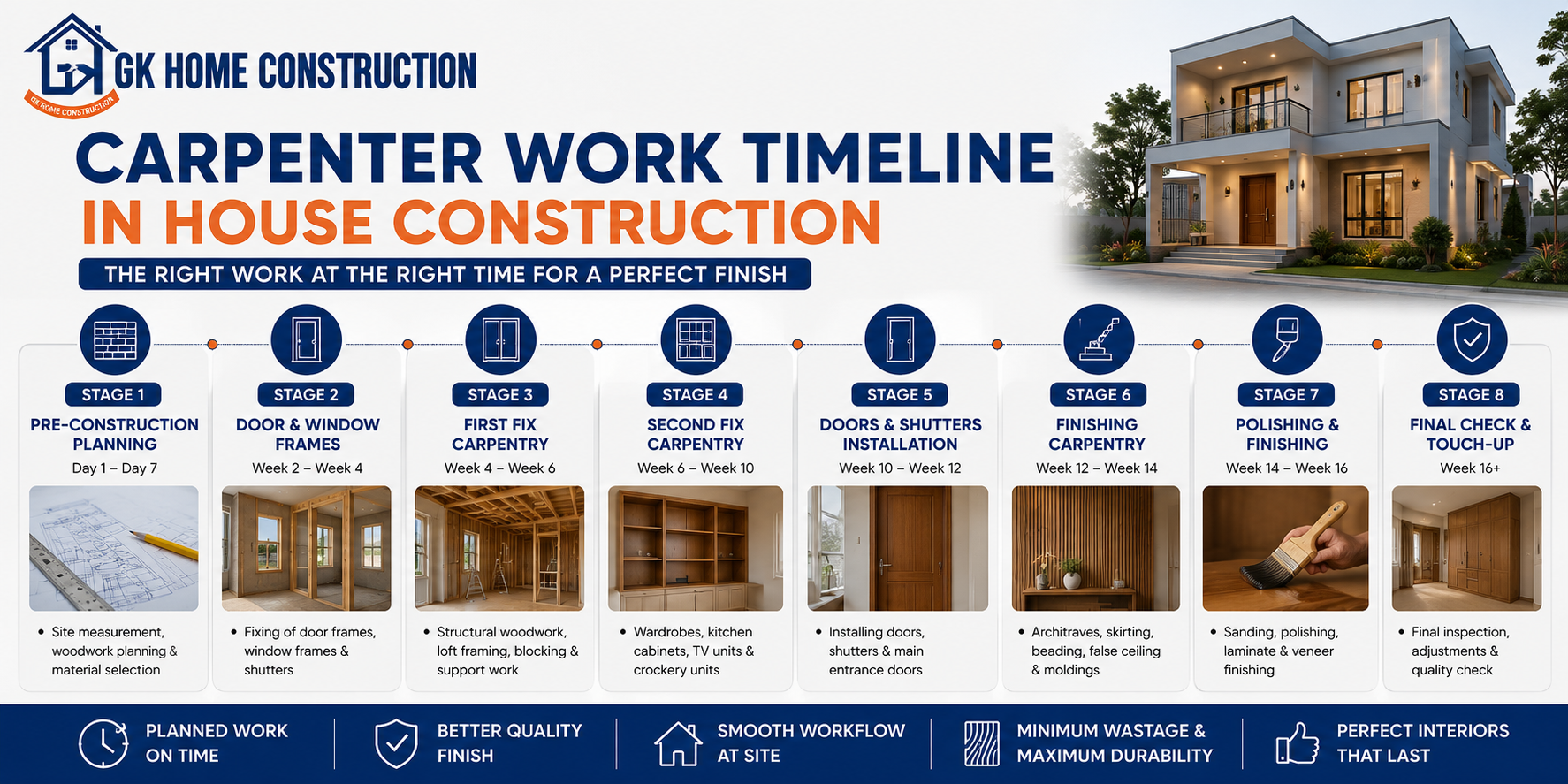
The overall carpenter work timeline for a standard residential house, from structural framing to furniture installation, spans roughly twelve to twenty weeks, spread across different phases of construction. The key to keeping this on track is early planning, timely procurement of materials, and clear communication between the site engineer, architect, and lead carpenter.
At GK Home Construction, we integrate carpenter work scheduling into our master project timeline from day one. Learn more about our carpentry services and how we manage every phase from framing to final furniture installation. This ensures that each carpentry phase begins exactly when the preceding civil or finishing work is ready, with no idle waiting time or rushed execution. A well-managed carpenter timeline is not just about speed—it is about delivering a home where every joint, frame, and finish reflects lasting quality craftsmanship.