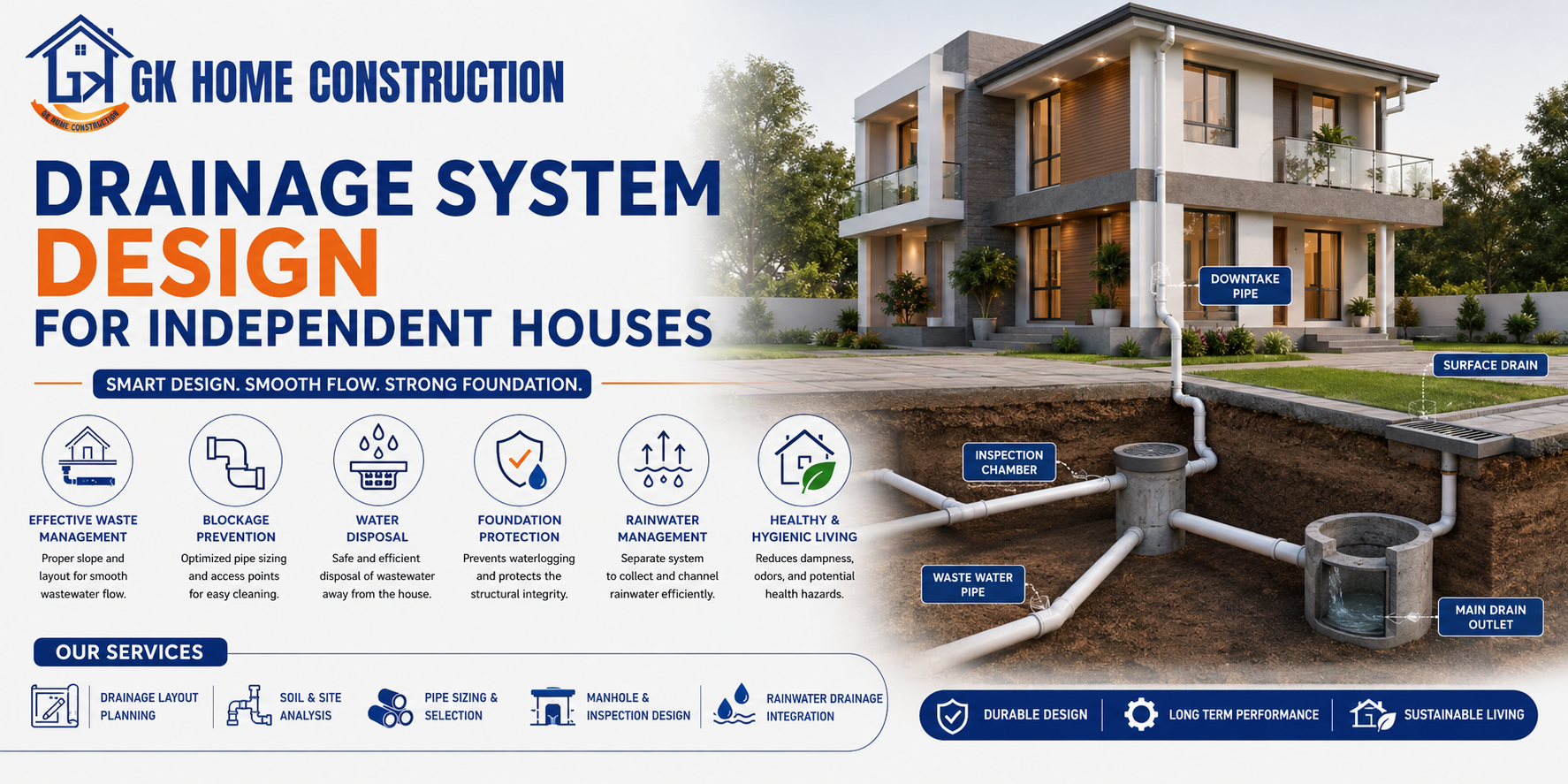
Drainage System Design for Independent Houses: Everything You Need to Know
When you build an independent house, most of your attention naturally goes toward the structure, interiors, and aesthetics. But one of the most critical and often underestimated aspects of home construction is the drainage system. A well-planned drainage system protects your property from waterlogging, structural damage, and health hazards. At GK Home Construction, we treat drainage design as a foundational element — not an afterthought — because a home built without proper drainage is a home that will cost you heavily in the years ahead.
Why Drainage System Design Matters More Than You Think
Most homeowners realize the importance of drainage only after they face a crisis — a flooded basement, cracks in the foundation, or a foul smell that refuses to go away. The truth is, water is the silent enemy of any structure. When water does not flow away efficiently, it seeps into walls, weakens the foundation, damages flooring, and creates a breeding ground for mosquitoes and bacteria. A properly designed drainage system ensures that rainwater, wastewater, and groundwater are all managed in a controlled and systematic way. This is especially important for independent houses, where you do not share infrastructure with a large apartment complex and are entirely responsible for your own water management.
Types of Drainage Systems Used in Independent Houses
Understanding the different types of drainage systems helps you make informed decisions during the construction phase. There are primarily three categories to consider for an independent house.
The first is the surface drainage system, which manages rainwater and runoff on the ground level. This involves sloping your plot, driveways, garden areas, and open spaces in a way that water naturally flows toward collection points or the municipal drain. Even a slight improper slope can cause water to stagnate near your walls or enter your home during heavy rains.
The second is the subsurface drainage system, which deals with water that collects below the ground level. This is particularly important if your plot has a high water table or if you have a basement or lower ground floor. Perforated pipes and gravel trenches are commonly used to redirect underground water away from the foundation before it causes structural damage.
The third is the internal plumbing and sewage drainage system, which manages wastewater from your kitchen, bathrooms, and toilets. This system connects to either the municipal sewage line or a septic tank, depending on the location and availability of civic infrastructure in your area.
Key Principles of Designing an Effective Drainage System
Designing a drainage system for an independent house is not a one-size-fits-all process. It depends on your plot's topography, soil type, local rainfall patterns, and the layout of your home. However, there are certain core principles that every good drainage design follows.
Gravity is the most powerful tool in drainage engineering. Every pipe, channel, and surface should be sloped to use gravity to move water away from the structure. Standard slope recommendations for drainage pipes range between 1% and 2%, meaning the pipe drops one to two centimeters for every one meter of horizontal length. Deviating from this can either cause water to flow too slowly, leading to blockages, or too fast, causing erosion and noise.
Pipe sizing is another critical factor. Undersized pipes get overwhelmed during heavy rainfall and back up into the house. Oversized pipes, on the other hand, may not maintain enough velocity to carry solid waste, leading to sedimentation and blockages over time. A professional drainage designer calculates the required pipe diameter based on the expected water volume and the connected load.
Rainwater Harvesting Integration
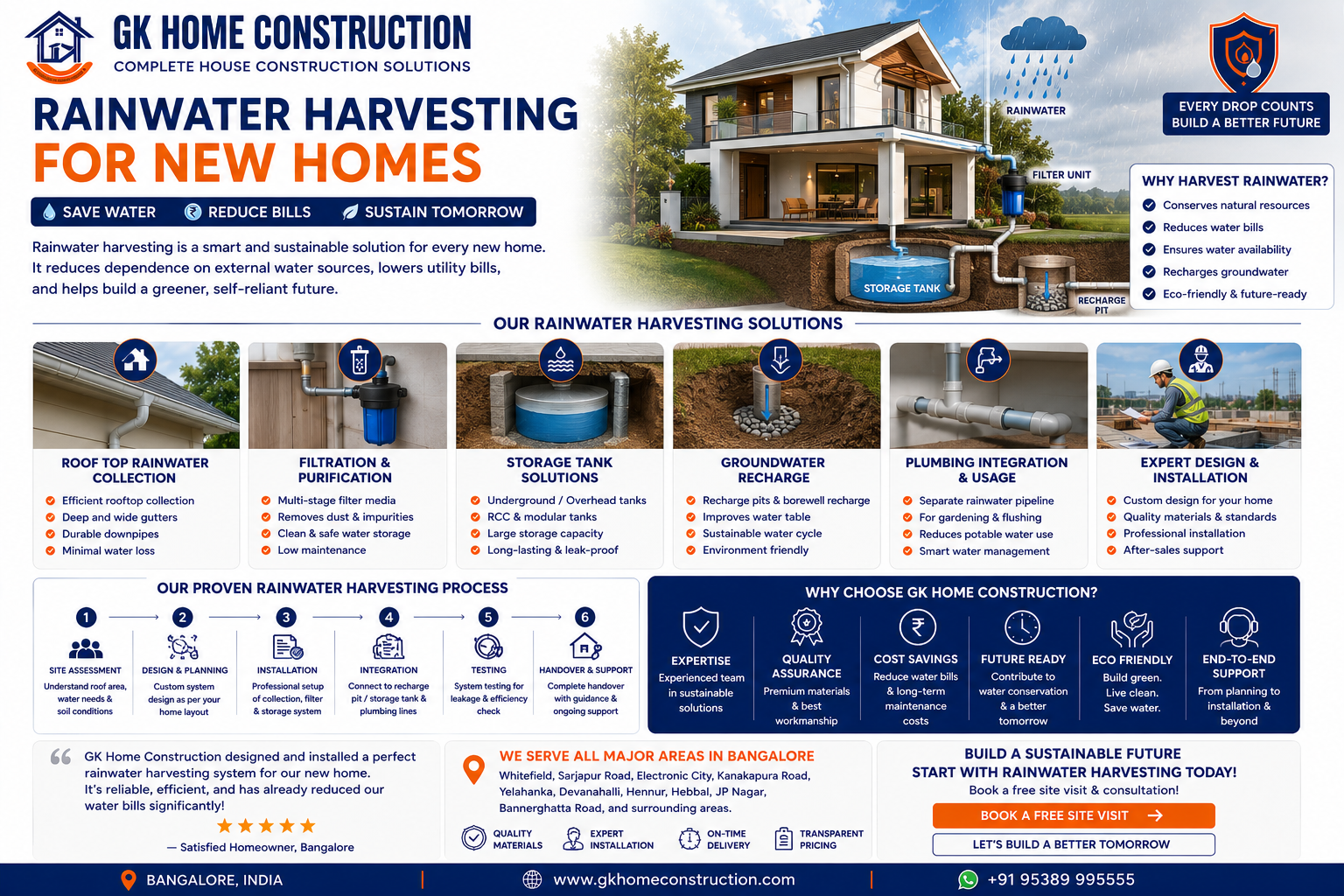
In today's construction environment, a drainage system should not simply dispose of water — it should also help you harvest and reuse it. Rainwater harvesting systems can be integrated into your drainage design from the very beginning, allowing you to collect rooftop runoff into underground sumps or recharge pits. This is not only environmentally responsible but also economically beneficial, especially in cities like Bengaluru where groundwater depletion is a serious concern. At GK Home Construction, we design drainage systems that allow seamless integration of rainwater harvesting without disrupting the overall water flow management of the property.
Common Drainage Mistakes to Avoid
Many construction errors related to drainage happen due to a lack of planning or shortcuts taken during execution. One of the most common mistakes is placing drain outlets too close to the foundation walls. Even if water is draining, if the outlet is near the foundation, it can still seep inward over time. Another frequent mistake is not accounting for the final landscaping levels. Many homeowners add garden soil or paving after construction, unknowingly blocking drainage paths that were carefully designed earlier.
Ignoring the need for cleanouts and access points is another costly oversight. Drainage pipes need periodic cleaning and maintenance. Without proper access points, any blockage becomes an expensive excavation job. Also, using substandard pipe materials to save costs often leads to cracks, leaks, and root intrusion within just a few years of construction.
The Role of Professional Expertise in Drainage Planning
Drainage system design is a technical discipline that combines civil engineering knowledge with site-specific analysis. While it may seem like a straightforward task, the variables involved — soil permeability, rainfall intensity, building load, municipal connection points — require professional assessment and design. Attempting to plan this without expertise often leads to expensive corrective work after construction is complete.
At GK Home Construction, our team conducts a thorough site evaluation before drafting the drainage layout. We consider the existing topography, future landscaping plans, municipal infrastructure availability, and the specific needs of the household to deliver a drainage solution that works reliably for decades.
Building Right from the Ground Up
A beautiful home deserves a strong and well-thought-out foundation, and that foundation includes everything that happens beneath and around your house. Investing in a proper drainage system during the construction phase saves you from spending many times more on repairs, waterproofing, and structural corrections later. At GK Home Construction, we believe that good construction is about building homes that remain strong, safe, and comfortable through every season — and that begins with getting the drainage right, from day one.