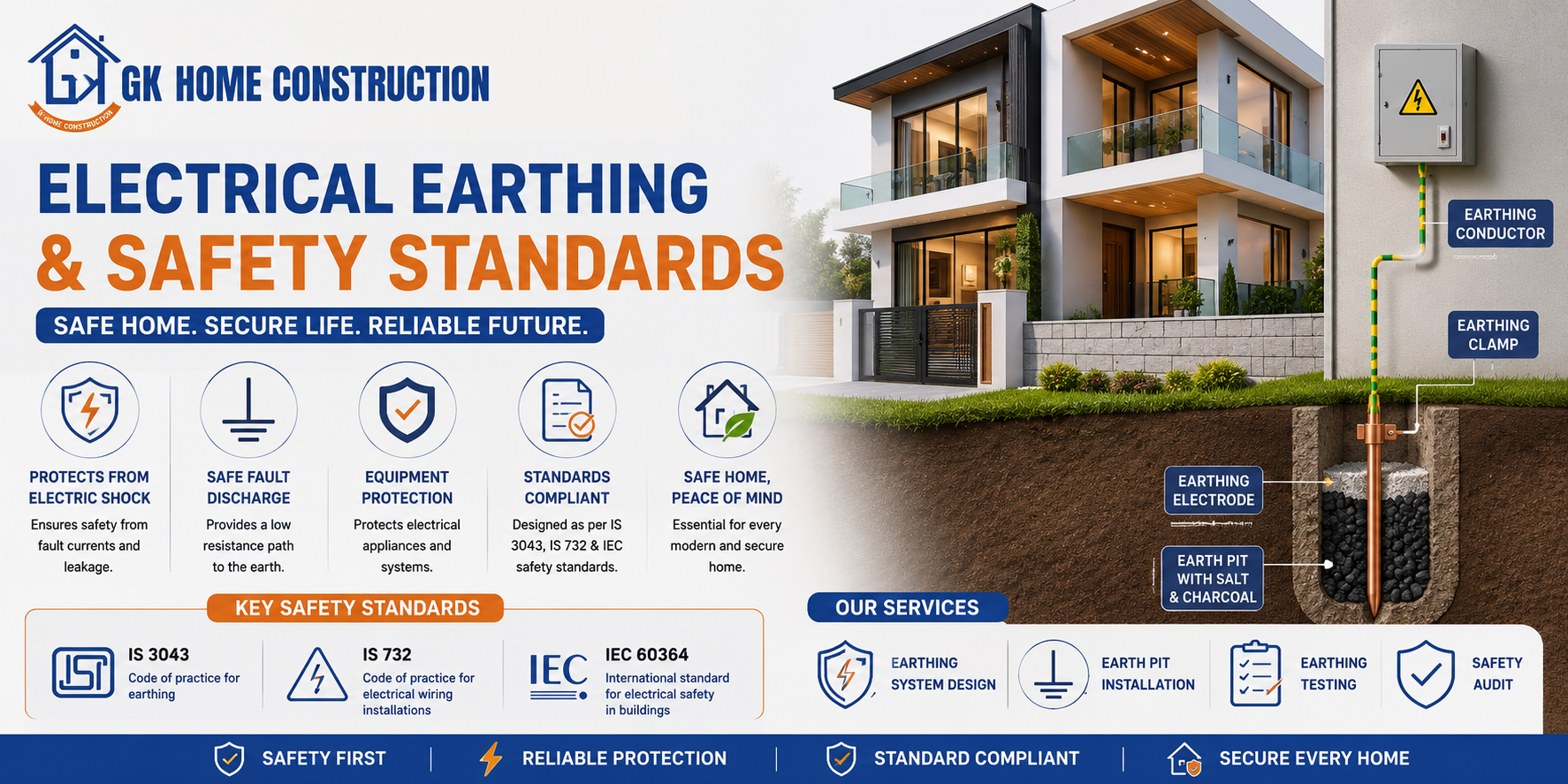
Electrical Earthing & Safety Standards: What Every Homeowner Must Know
When we talk about building a safe home, we often focus on strong walls, quality flooring, and reliable plumbing. But one of the most critical — and frequently overlooked — aspects of home construction is electrical earthing. At GK Home Construction, we believe that a truly safe home is one where every electrical system is properly grounded and built to meet the highest safety standards. Understanding earthing is not just a technical requirement; it is a life-saving measure that every homeowner, builder, and contractor must take seriously.
What Is Electrical Earthing and Why Does It Matter?
Electrical earthing, also known as grounding, is the process of connecting the electrical system of a building directly to the ground through a conducting path. The purpose of this connection is to provide a safe route for excess electrical current to flow into the earth whenever there is a fault, surge, or short circuit in the system. Without proper earthing, any electrical fault can turn a metal appliance, a switchboard, or even a wall into a dangerous live surface, putting residents at severe risk of electric shock or fire.
Think of earthing as the safety net of your home's electrical infrastructure. When something goes wrong — and in electrical systems, faults are never fully avoidable — the earth connection ensures that the dangerous current finds a path that leads it away from human contact. This fundamental safety principle is what makes earthing an absolute non-negotiable in every residential, commercial, and industrial construction project.
The Core Principles Behind a Proper Earthing System
A well-designed earthing system works on a straightforward but precise principle: provide a low-resistance path between the electrical installation and the ground. The earth electrode, which is typically a copper rod or a galvanized iron rod, is buried deep into the soil at a point where the ground has adequate moisture and conductivity. From this electrode, a thick earthing conductor runs back into the building's electrical panel, connecting all metal enclosures, appliances, and exposed conductive parts of the system to the ground.
The resistance of the earth electrode must be kept as low as possible — ideally below 1 ohm for industrial setups and below 5 ohms for domestic installations, as per the Bureau of Indian Standards (BIS) and the Indian Electricity Rules. If resistance is too high, the earthing system will not function effectively during a fault, and the protective devices like circuit breakers and fuses may fail to trip in time. This is why soil testing and electrode depth are critical decisions that must be made by qualified electrical engineers before construction begins.
Types of Earthing Used in Residential Construction
In home construction, there are several types of earthing systems that are commonly used depending on the soil type, building design, and local electrical codes. Plate earthing involves burying a large copper or galvanized iron plate vertically in moist soil and is widely used across India for residential buildings. Pipe earthing, on the other hand, involves driving a galvanized iron or steel pipe deep into the ground and is considered one of the most reliable methods for locations with dry or sandy soil, as the perforated pipe allows moisture to reach the electrode.
Strip or tape earthing is another method where a copper or GI strip is laid horizontally in a trench and is often used for large structures or where multiple earth connections are needed. At GK Home Construction, we assess each project individually to determine the most appropriate earthing method based on soil conditions, building size, and the type of electrical load the structure will carry. Choosing the wrong method or installing it incorrectly can render the entire system useless.
Indian Standards and Legal Compliance for Earthing
In India, electrical installations in buildings must comply with the Indian Electricity Rules, 1956, and follow the guidelines set by IS 3043 — the Code of Practice for Earthing, published by the Bureau of Indian Standards. These regulations specify everything from the minimum conductor size and electrode material to the depth of burial and the frequency of inspection and testing. Non-compliance with these standards is not just a technical failure — it is a legal violation that can expose builders and property owners to serious liability.
IS 3043 also mandates that all earthing systems be periodically tested and maintained. The earth electrode resistance must be measured at regular intervals, especially before the monsoon season, as soil moisture levels significantly affect conductivity. At GK Home Construction, every project we deliver includes a certified earthing installation that meets or exceeds these national standards, and we provide homeowners with documentation of all compliance tests performed.
Common Earthing Failures and How to Avoid Them
Despite its importance, earthing is one of the most commonly compromised aspects of electrical installations in India. One of the most frequent mistakes is using undersized earthing conductors that cannot carry fault current safely. Another is placing the earth electrode in dry or rocky soil without proper moisture conditioning, which dramatically increases resistance. In some cases, builders skip the earthing work entirely or create dummy earthing connections that appear complete but are not actually connected to the ground.
Poor quality materials are another serious concern. Using low-grade GI rods instead of certified copper electrodes, or skimping on the thickness of the earthing conductor, can cause the system to corrode and fail within a few years. At GK Home Construction, we source only BIS-certified materials for all our earthing installations and ensure every connection is made with proper clamps and fittings rather than temporary wire twists or tape wrappings.
Earthing as a Pillar of Responsible Home Construction
Electrical earthing is not a feature that can be added as an afterthought or treated as a box to check during inspection. It must be planned from the foundation stage, executed by licensed electricians, verified by independent testing, and maintained throughout the life of the building. When done right, earthing quietly protects your family every single day — you will never notice it, and that is exactly the point.
At GK Home Construction, our commitment to electrical safety reflects our broader philosophy: every home we build is built as if our own family will live in it. Earthing and electrical safety standards are not just codes we follow — they are values we uphold.