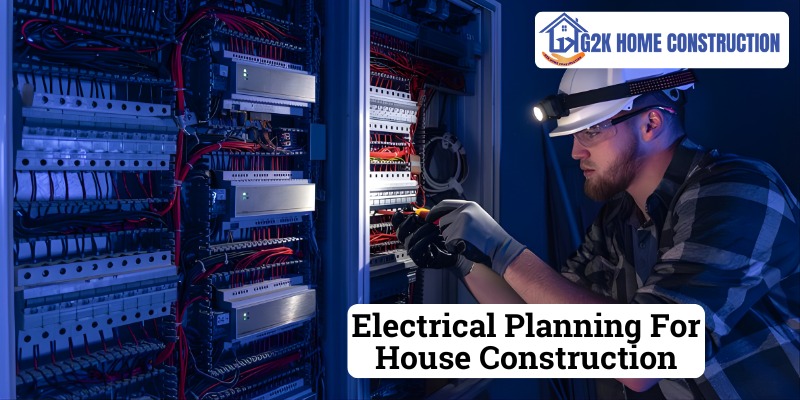
Electrical planning is one of the most important steps in new home construction, yet it is sometimes overlooked. A properly designed electrical system ensures your home's safety, convenience, energy efficiency, and future readiness. Changes to electrical schemes become costly and disruptive once walls and finishes are installed. As a result, meticulous planning during the early stages of building assists homeowners in avoiding typical mistakes and ensuring long-term satisfaction.
Key considerations at this level include:
- The number of family members and rooms
- Patterns of daily appliance usage.
- Requirements for studying or working from home
- Future plans for expansion or renovations
Budget and energy efficiency targets Every home is unique, and electrical requirements vary depending on factors such as family size, number of rooms, appliances, work-from-home needs, and future extension plans. Discussing these requirements with an experienced construction team ensures that the electrical architecture is based on actual usage rather than broad assumptions.
Calculating load is one of the initial tasks in electrical planning. This entails calculating the total electrical load for the house, which includes lighting, fans, air conditioners, kitchen appliances, water heaters, pumps, and other electrical devices. An accurate load calculation aids in determining the proper capacity for the main electrical panel, wiring size, and safety measures. Underestimating the load might result in repeated tripping and overheating, whilst overestimating can result in excessive expenses.
Lighting design is essential for improving the beauty and functionality of a home.
Lighting factors include:
- Ambient lighting increases overall brightness.
- Task illumination for kitchens, study areas, and workplaces
- Accent lighting may improve interiors and décor.
- LED fixtures are energy-efficient.
Optimal placement to prevent glare and shadows Each area requires a carefully balanced combination of ambient, task, and accent lighting. Layered lighting, including ceiling lights, wall lights, and focused lighting for seating areas, works well in living rooms. Bedrooms require comfortable lighting with bedside switches for added convenience. Kitchens demand strong task lighting for cooking areas, whilst bathrooms require moisture-proof fixtures with adequate illumination near mirrors.
Switch and socket placement should be arranged in accordance with furniture layout and usage patterns.
Best practices in switch and socket planning:
- Place switchboards at the room entrances.
- Provide enough sockets to prevent expansions.
- Plan charging points near beds and sofas.
- Allocate dedicated points for televisions and routers.
Keep regular heights for safety and convenience of use. Randomly placed switches frequently cause annoyance and clutter in wire additions. Switchboards should be placed at easily accessible heights and near room entrances. Televisions, charging stations, routers, home office equipment, and decorative lighting all require adequate power outlets. Planning extra sockets ahead of time helps to minimise excessive use of extension cords afterward.
Kitchen electrical design requires special consideration because it houses multiple high-load equipment.
Kitchen Electrical Checklist:
- Dedicated points for refrigerators and microwaves
- Separate circuits for the oven and dishwasher.
- Power points for the chimney and water purifier
- Effective earthing and MCB protection
Moisture-resistant switches and sockets. Refrigerator, microwave, oven, dishwasher, mixer, chimney, and water purifier all require dedicated power points. These appliances should be linked to separate circuits to avoid overloading. Proper earthing and high-quality wiring are critical for ensuring safety in a moisture-prone setting like the kitchen.
Bedrooms require well-planned electrical layouts for comfort and convenience. Along with lighting and fans, bedrooms frequently require charging connections near beds, as well as power outlets for televisions, air conditioners, and study tables. It is also necessary to have inverter or backup power points for key items like lights and fans, especially in places where power outages are common.
Bathrooms and utility spaces require extra precautions to ensure safety. To avoid electrical risks, waterproof switches, covered sockets, and correct earthing must be installed. Geysers should be wired in separate circuits with appropriate isolator switches located outside the bathroom. Exhaust fans and lighting fixtures should be made to tolerate humidity and water.
The quality of electrical wiring has a direct impact on the system's safety and durability. Using high-quality copper wires with enough insulation decreases the risk of short circuits and fires. Concealed wiring is generally desired in modern homes for its clean appearance, but it must be done carefully with the proper conduits and junction boxes. Labelling circuits during installation allows for easier maintenance and troubleshooting in the future.
Distribution boards and circuit breakers are essential components of a safe electrical system. Each main location or appliance should have its own circuit protected by suitable MCBs and RCCBs. This guarantees that a fault in a single circuit does not affect the whole house. The proper location of the distribution board enables for simple access during emergencies and routine checks.
Energy efficiency is an essential component of modern electrical design. Choosing LED lighting, energy-efficient fans, and equipment with high efficiency ratings helps to cut electricity use and monthly expenditures. Planning for natural lighting and ventilation also reduces the need for artificial lighting during the day. Smart electrical planning promotes sustainability while also providing long-term cost benefits.
With the growing popularity of smart homes, future-proof electrical planning has become critical. Smart switches, automation systems, CCTV cameras, video door phones, and Wi-Fi routers should all be included during building. Installing conduits and wiring routes for future improvements saves wall-breaking and additional costs in the long run.
Backup power preparation is another critical aspect. Homes should include inverter or generator connections for critical circuits like as lighting, fans, refrigerators, and internet gadgets. Separate wiring for backup power ensures that the system runs smoothly during power outages and does not overload.
Safety should always be the first priority in electrical design.
Important electrical safety measures:
- proper earthing for all circuits
- RCCB and MCB safeguards
- Surge protection devices.
- Lightning arrestors for individual dwellings
Conformity to local electrical standards Proper earthing of all electrical points, surge protection devices, and lightning arrestors in independent households serve to protect both occupants and appliances. Regular inspections throughout construction ensure that all electrical safety requirements and local legislation are met.
Coordination of electrical planning and other construction operations is critical. Electrical layouts must be consistent with architectural designs, plumbing lines, false ceilings, and interior elements. Early coordination prevents clashes, rework, and delays during construction.
To summarise, electrical planning for new home building is a critical stage that affects safety, comfort, and functionality for years to come. Investing effort in comprehensive design, employing high-quality materials, and collaborating with skilled professionals results in a dependable and future-ready electrical system. GK Home Construction incorporates rigorous electrical planning into the construction process to create homes that are safe, efficient, and intended for modern living.
Contact Details – GK Home Construction
If you are planning to build a home and looking for trusted civil construction contractors in Bangalore, you can reach out to GK Home Construction through the following official channel:
Company Name: GK Home Construction
Website: https://gkhomeconstruction.com/
Email : care@gkhomeconstruction.com
Call us at : +91 9538999535
(For enquiries, consultations, and project discussions, Contact now.)