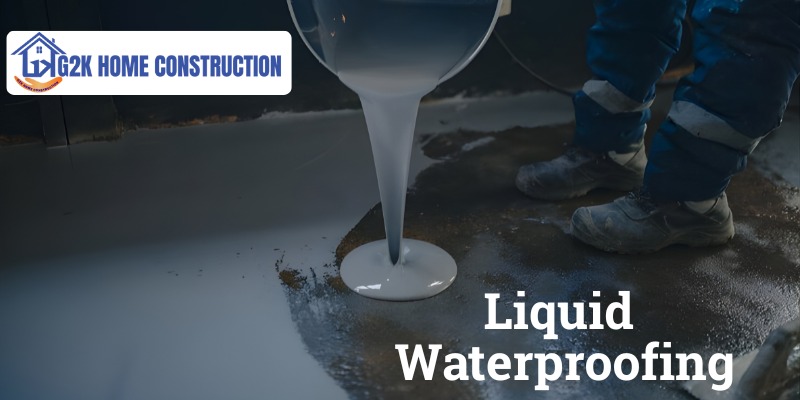
A liquid-based chemical coating is applied to a surface (roof, bathroom, basement, etc.) using the liquid waterproofing method. The coating dries to create a smooth, rubber-like waterproof membrane.
It can stretch without breaking and is strong and flexible.
It can stretch without breaking and is strong and flexible.
Common materials used:
- Acrylic liquid membrane
- Polyurethane (PU) liquid membrane
- Bituminous liquid membrane
- Hybrid polymer coating
2. Types of Liquid Waterproofing
- Acrylic Liquid Waterproofing
- Water-based coating
- Easy to apply
- Good for roofs, walls, and bathrooms
- UV-resistant
- Moderate flexibility
Durability: 5–7 years
Cost: Low to medium
Cost: Low to medium
2. Polyurethane (PU) Liquid Waterproofing
- Highly flexible (up to 300% elasticity)
- Excellent crack-bridging
- Seamless rubber-like finish
- Good for roof terraces, balconies & critical areas
Durability: 10–15 years
Cost: High
Cost: High
3. Bituminous Liquid Waterproofing
- Bitumen-based black liquid coating
- Good adhesion, economical
- Mainly used for foundations, basements, and retaining walls.
Durability: 5–8 years
Cost: Low
Cost: Low
4. Polymer Modified Liquid Waterproofing
- Cement + polymer combination
- More flexible and stronger than plain cementitious
- Used in wet areas & walls
Durability: 6–8 years
Cost: Low to medium
Cost: Low to medium
5. Hybrid (Polymer + PU/Acrylic Mix) Liquid Membranes
- A blend of polymers, PU, and acrylic
- Faster curing, high strength
- Suitable for terraces, water tanks, and bathrooms
Durability: 8–12 years
Cost: Medium to high
Cost: Medium to high
6. Epoxy Liquid Waterproofing
- Very strong and chemical-resistant
- utilized in basements, water tanks, and industrial floors
- Less flexible than PU
Durability: 10–12 years
Cost: High
Cost: High
7. Liquid Rubber Coatings
- Extremely elastic (400–800% stretch)
- UV-resistant
- Used on roofs, metal sheets, asbestos sheets
Durability: 10–12 years
Cost: Medium to high
Cost: Medium to high
3. Areas where Liquid Waterproofing is Used
- Bathrooms & toilets
- Terraces & roofs
- Balconies
- Kitchens
- Exterior walls
- Water tanks (external side)
- Basements
- Metal roofs
4. Liquid Waterproofing – Stage-by-Stage
- Surface Preparation
- Clean dust, dirt, algae, and loose particles.
- Repair cracks with crack filler or polymer mortar.
- Ensure the surface is dry and smooth.
2. Apply Primer
- To increase the chemical’s adherence to the surface, a primer is used.
- Allow it to dry, which usually takes one to two hours.
3. Apply First Coat of Liquid Waterproofing
- You can apply it with a brush, roller, or sprayer…
- Apply an even, uniform coat.
4. Reinforcement (Optional but recommended)
- For further robustness, cover the initial wet coat with non-woven fabric or fiberglass mesh.
5. Apply Second Coat
- The second coat should be applied once the first coat has dried.
- Make sure there are no gaps or areas that are overlooked.
6. Curing Time
- Allow 24 to 48 hours (depending on the product) for complete curing
5. Pros
- Seamless membrane → No joints, no leakage paths
- Very flexible → Handles surface cracks
- Easy application
- Good for complex shapes and penetrations
- Fast curing
- UV-resistant (for acrylic/PU types)
6. Cons
- Surface must be well-prepared
- Requires correct thickness
- Some materials (PU) are costlier.
- May need protection screed in high-traffic areas
- Sensitive to moisture during curing
Contact Details – GK Home Construction
If you are planning to build a home and looking for trusted civil construction contractors in Bangalore, you can reach out to GK Home Construction through the following official channel:
Company Name: GK Home Construction
Website: https://gkhomeconstruction.com/
Email : care@gkhomeconstruction.com
Call us at : +91 9538999535
(For enquiries, consultations, and project discussions, Contact now.)