TMT Steel Grades Explained: Fe-415 vs Fe-500 vs Fe-550
— Which Is Right for Your Home?
When building a home, most homeowners focus on design, elevation, and finishes. However, the real strength of any structure lies in what you don’t see—its structural framework. One of the most critical components of this framework is TMT steel. Choosing the right TMT steel grade is not just a technical decision; it directly impacts the safety, durability, and longevity of your home.
In today’s construction landscape, Fe-415, Fe-500, and Fe-550 are the most commonly used TMT steel grades. While they may sound similar, each grade serves a specific purpose. Understanding their differences can help you make smarter and more cost-effective decisions for your dream home.
When building a home, most homeowners focus on design, elevation, and finishes. However, the real strength of any structure lies in what you don’t see—its structural framework. One of the most critical components of this framework is TMT steel. Choosing the right TMT steel grade is not just a technical decision; it directly impacts the safety, durability, and longevity of your home.
In today’s construction landscape, Fe-415, Fe-500, and Fe-550 are the most commonly used TMT steel grades. While they may sound similar, each grade serves a specific purpose. Understanding their differences can help you make smarter and more cost-effective decisions for your dream home.
What Does TMT Steel Grade Mean?
TMT stands for Thermo-Mechanically Treated steel, a type of reinforcement bar widely used in construction. The “Fe” in Fe-415, Fe-500, or Fe-550 stands for iron, while the number represents the minimum yield strength of the steel in megapascals (MPa).
In simple terms, yield strength indicates how much stress the steel can withstand before it begins to deform permanently. The higher the number, the stronger the steel. However, strength is not the only factor to consider—flexibility, ductility, and application also play equally important roles.
Understanding Fe-415 TMT Steel
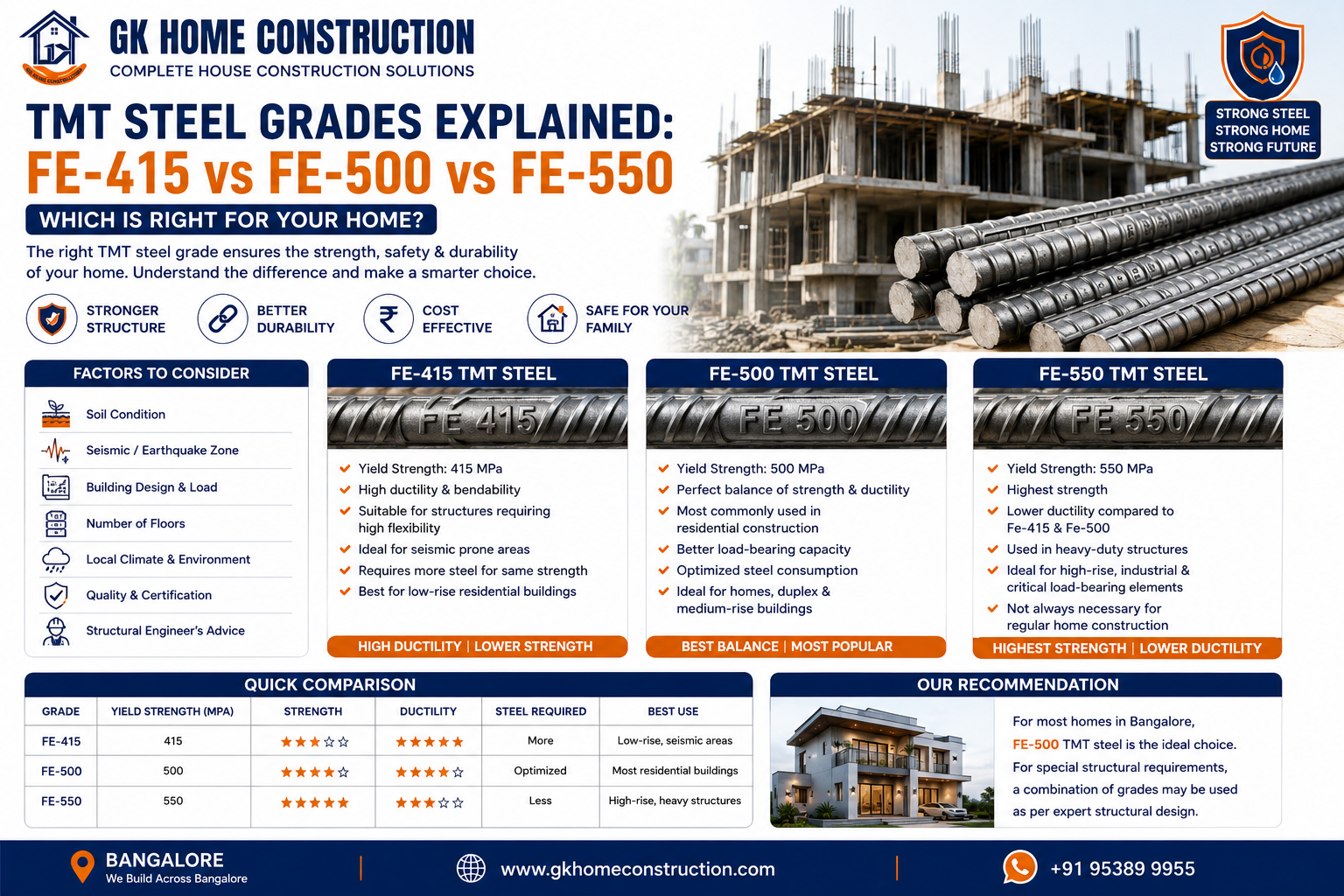
Fe-415 is one of the older and more traditional grades of TMT steel. It has a yield strength of 415 MPa and is known for its high ductility. This means it can bend easily without breaking, making it suitable for structures that require flexibility.
This grade is often used in smaller residential constructions, especially in areas where seismic activity is a concern. Its ability to absorb stress and deform without sudden failure makes it a safer option in certain scenarios.
However, Fe-415 has lower strength compared to higher grades, which means you may need more steel to achieve the same structural integrity. This can sometimes increase the overall construction cost due to increased material use.
Understanding Fe-500 TMT Steel
Fe-500 is currently the most widely used TMT steel grade in residential construction across Bangalore and other urban areas. With a yield strength of 500 MPa, it offers a strong balance between strength and ductility.
This grade is ideal for most types of home construction, including independent houses, duplex homes, and even small apartment buildings. It provides greater load-bearing capacity than Fe-415, enabling more efficient structural design and reduced steel consumption.
Another advantage of Fe-500 is its versatility. It performs well in both normal and moderately challenging environmental conditions. For most homeowners, this grade offers the perfect combination of safety, durability, and cost-effectiveness.
Understanding Fe-550 TMT Steel
Fe-550 is a high-strength TMT steel grade with a yield strength of 550 MPa. It is primarily used in heavy-duty construction projects such as high-rise buildings, bridges, and industrial structures.
While it offers superior strength, Fe-550 comes with reduced ductility compared to Fe-415 and Fe-500. This means it is less flexible and may not be ideal for structures that require significant stress absorption, especially in earthquake-prone areas.
In residential construction, Fe-550 is generally used selectively, such as in columns or load-bearing elements where higher strength is required. Using it throughout a home without proper structural design may not be necessary and could increase costs without significant benefits.
Key Differences Between Fe-415, Fe-500, and Fe-550
The primary difference between these grades lies in their strength and flexibility. Fe-415 is more ductile but less strong, making it suitable for flexible structures. Fe-500 strikes a balance between strength and ductility, making it the most practical choice for homes. Fe-550 offers the highest strength but compromises on flexibility, making it more suitable for specialized applications.
Another important factor is cost efficiency. Higher-grade steel, such as Fe-550, may reduce the amount of steel required but often comes at a higher price per unit. On the other hand, Fe-415 may be cheaper per unit but requires more quantity. Fe-500 typically offers the best balance between cost and performance.
Which TMT Steel Grade Is Right for Your Home?
For most residential projects in Bangalore, Fe-500 is the recommended choice. It provides sufficient strength to support modern home designs while maintaining enough flexibility to handle environmental stresses.
Factors to Consider Before Choosing TMT Steel
Before finalizing the steel grade for your home, consider factors such as soil condition, building design, number of floors, and local climate. For example, areas with weak soil may require stronger reinforcement, while regions with high seismic activity may benefit from more ductile steel.
It is also essential to ensure that the TMT steel you use is certified and meets quality standards. Even the best grade will fail if the material quality is compromised. Always source steel from trusted brands and verify test certificates.
Common Mistakes Homeowners Should Avoid
One of the most common mistakes is assuming that a higher grade automatically means better quality. While Fe-550 is stronger, it is not always the best choice for every part of a home. Overusing high-strength steel can lead to unnecessary expenses without improving safety.
Another mistake is ignoring the role of a structural engineer. Steel selection should always be based on proper structural calculations rather than guesswork or cost-cutting decisions.
Finally, some homeowners try to reduce costs by opting for lower-grade steel without understanding the long-term risks. This can compromise the building's structural integrity and lead to expensive repairs in the future.
Final Thoughts
Choosing the right TMT steel grade is a crucial step in building a safe and durable home. While Fe-415, Fe-500, and Fe-550 each have their advantages, the best choice depends on your specific construction requirements.
For most homeowners, Fe-500 offers the ideal balance of strength, flexibility, and cost. However, a thoughtful combination of different grades, guided by expert advice, can ensure optimal performance and long-term reliability.