
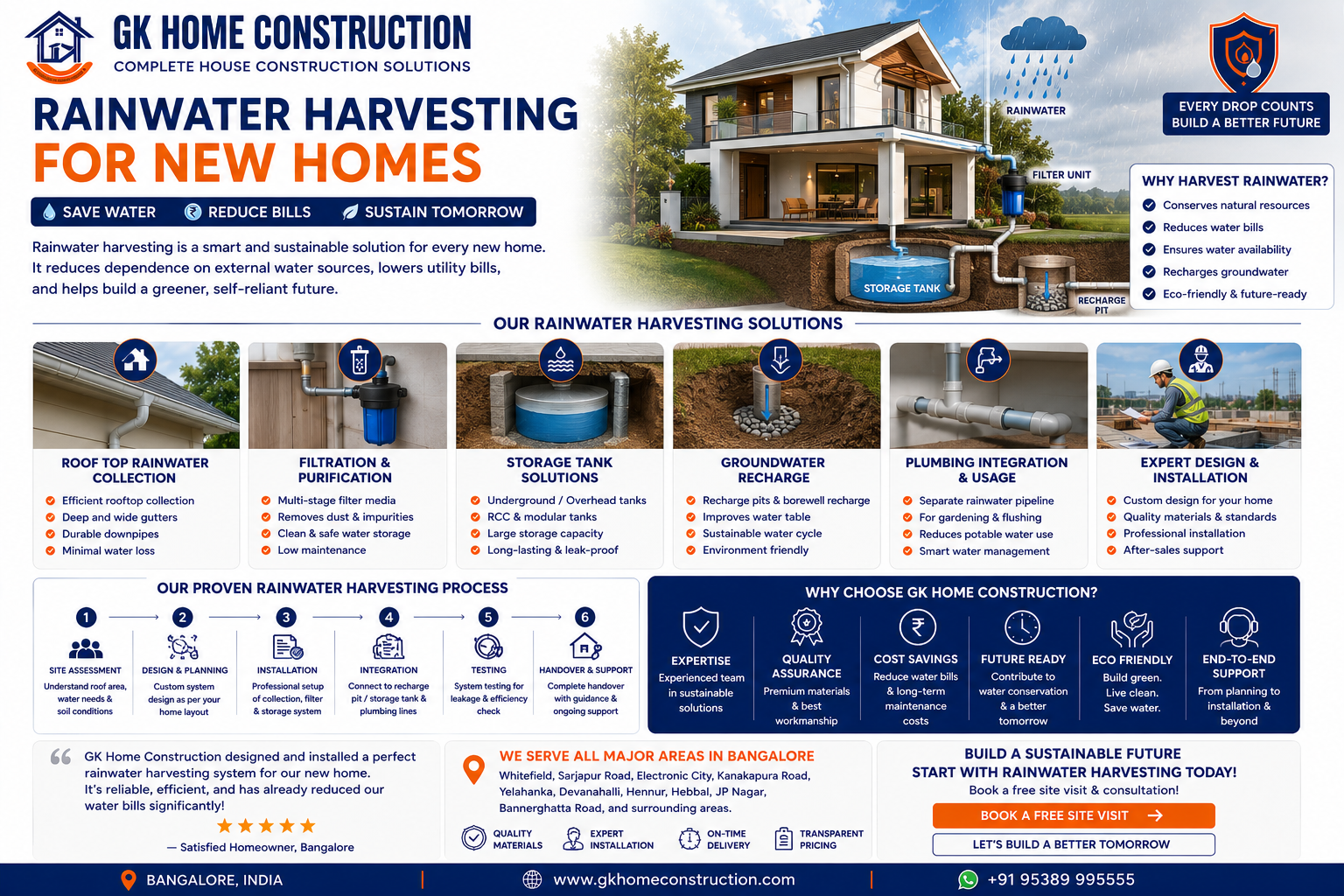
Rainwater Harvesting for New Homes:Planning and Benefits
Water has become one of the most valuable resources for every homeowner in Bangalore. With rapid urbanization, unpredictable rainfall patterns, and increasing dependence on groundwater, conserving water is no longer an option—it is a necessity. One of the smartest ways to achieve this is to incorporate a rainwater harvesting system when constructing a new home. Unlike retrofitting an existing property, planning rainwater harvesting during the construction phase ensures better efficiency, lower installation costs, and seamless integration with your home's design.
Rainwater harvesting for new homes can be done by collecting the rainwater through the roof and processing it for later use or directing it into a professionally constructed groundwater recharge system. This allows a homeowner to incorporate a series of underground pipes, filters, cisterns, and recharge pits during the construction process.
At GK Home Construction, we believe that every modern home should be designed not only for comfort but also for sustainability. Rainwater harvesting is one of the most practical investments homeowners can make because it reduces water bills, supports groundwater recharge, and contributes to a greener environment. If you are planning to build your dream home in Bangalore, understanding how rainwater harvesting works can help you make informed decisions from the very beginning.
Key Benefits of Rainwater Harvesting for New Homes
- Reduces dependence on municipal water and tanker supplies
- Collects rainwater for suitable non-drinking uses
- Supports groundwater recharge when the site is suitable
- Helps manage rooftop rainwater runoff
- Allows the system to be integrated into the construction plan
- Supports more responsible water management
Rainwater harvesting is the process of collecting, filtering, storing, and utilizing rainwater that falls on rooftops and other surfaces. Instead of allowing rainwater to flow into storm drains and ultimately be wasted, a properly designed harvesting system captures it for future use or directs it into the ground to replenish groundwater.
For independent homes, the rooftop acts as the primary catchment area. During rainfall, water flows through gutters and downpipes into a filtration system. After filtration, the water can either be stored in underground or overhead tanks for domestic use or diverted into recharge pits that help replenish underground aquifers.
By integrating this system during construction, homeowners can ensure maximum efficiency without affecting the architectural appearance of the property.
Why Rainwater Harvesting Is Essential for New Homes in Bangalore
Bangalore has experienced significant changes in water availability over the past decade. As the city's population continues to grow, groundwater levels are declining in many residential areas. Many homeowners depend on borewells or water tankers, both of which can become expensive over time.
Rainwater harvesting offers a reliable supplementary water source that reduces dependence on external supplies. Since Bangalore receives substantial rainfall during the monsoon seasons, every rooftop has the potential to collect thousands of liters of water each year.
Building a home with an integrated rainwater harvesting system also ensures compliance with local building regulations, as many residential developments encourage or require sustainable water management practices. More importantly, homeowners gain peace of mind knowing they have an additional water resource during periods of shortage.
Prior to finalizing the system, the homeowners must consider the size of the available rooftop catchment, local rainfall, soil, site drainage, and water demand. This will assist them in finalizing whether the harvested water should be stored for secondary use or diverted to a recharge structure or a combination of both.
How Much Rainwater Can a House Collect?
The effectiveness of a rainwater harvesting system depends on proper planning and execution. During a new home construction project, each component is carefully designed to work together efficiently.
The process begins with the rooftop, which serves as the collection surface. Rainwater falling on the roof is directed toward strategically placed gutters that carry the water into PVC downpipes. These pipes transport the water safely without causing leakage or structural damage.
Before entering the storage or recharge system, the water passes through a first-flush mechanism. This device diverts the initial rainwater, which often contains dust, leaves, bird droppings, and other contaminants accumulated on the roof. Once the initial runoff is discarded, cleaner rainwater enters the filtration unit.
The filtration system usually consists of multiple layers such as gravel, coarse sand, charcoal, and fine sand. Modern filtration units may also include stainless steel mesh filters or advanced cartridge filters that remove suspended particles while maintaining a steady water flow.
After filtration, the clean water is either stored in a dedicated underground sump or directed into recharge pits. Stored water can later be pumped for gardening, flushing toilets, washing vehicles, cleaning outdoor spaces, and, with appropriate treatment, even household use.
Recharge pits allow excess water to seep naturally into the ground, restoring groundwater levels and improving borewell performance over time.
The amount of water that can be collected from a roof depends on the size of the roof, the amount of rainfall, and the efficiency of the collection system. One way to estimate how much water you could collect is with this equation:
Potential collection (in litres) = Roof top area (in m2) × Rainfall (in mm) × Runoff coefficient
Using this formula, a roof with an area of 100 m2 and 800 mm of rainfall could yield 64,000 litres of water (based on a runoff coefficient of 0.8), before taking into account any losses in the system and other factors.
This is an approximate value, which does not take into account other variables. The actual amount of water you can collect will depend on the rainfall, the roof material, the first-flush diverter, the filters, the storage tanks and the overflows.
Components of a Rainwater Harvesting System
Every rainwater harvesting system consists of several important components that work together efficiently. The rooftop catchment collects rainfall, while gutters and downpipes transport the water safely. A first-flush diverter removes initial impurities before filtration begins. The filtration unit ensures cleaner water by eliminating debris and sediment.
Storage tanks preserve collected water for future use, whereas recharge pits or recharge wells allow surplus water to replenish groundwater reserves. Overflow pipes prevent waterlogging by safely directing excess water away during heavy rainfall. Proper planning ensures all these components function effectively without affecting the aesthetics or structural integrity of the house.
Rainwater Storage vs Groundwater Recharge:Which is Better?
Rainwater storage and recharge systems are fundamentally different. A storage tank collects water for later use, such as irrigation, car washing, and toilet flushing, provided that the quality is suitable. A recharge pit or well allows for the collection of water and its return to the groundwater reservoir through natural infiltration if the geology and hydrology are appropriate.
These two options may be combined in some cases, but the choice depends on the size of the roof, water needs, space, and soil permeability. It is better to consult with a professional contractor to select the most appropriate solution in each case.
Benefits of Installing Rainwater Harvesting During Construction
Installing rainwater harvesting during the construction phase provides several long-term advantages. Since the plumbing layout, underground tanks, and recharge pits can be incorporated into the original building design, installation becomes more economical than adding the system later.
The system significantly reduces dependence on municipal water supplies and expensive tanker services. Over time, homeowners experience noticeable savings on water expenses while enjoying improved water security.
Rainwater harvesting also helps reduce urban flooding by minimizing stormwater runoff around residential properties. Instead of overwhelming drainage systems, rainwater is effectively utilized or absorbed into the ground.
Another major benefit is environmental sustainability. Conserving freshwater resources reduces pressure on lakes, rivers, and groundwater reserves while promoting responsible water management for future generations.
Homes equipped with sustainable features like rainwater harvesting often attract environmentally conscious buyers and may enjoy better long-term property value.
How to Plan a Rainwater Harvesting System During Construction
- Measure the area of the rooftop that can be used for harvesting.
- Estimate the amount of rainfall and the potential volume of water that could be collected.
- Conduct a survey of the site and existing soil conditions prior to designing recharge structures.
- Based on demand assessment decide on the capacity of storage reservoirs.
- Layout the pipes, filters, first flush, and overflow pipes.
- Ensure accessibility for cleaning, inspection, and maintenance.
- Check if any local building or water management regulations apply
The size of storage tanks and recharge pits is then determined according to the expected water collection and the family's daily water requirements. Pipe routing, filtration systems, overflow mechanisms, and maintenance access points are carefully incorporated into the building plan.
At GK Home Construction, rainwater harvesting is considered an integral part of sustainable home construction rather than an optional feature. By coordinating civil work, plumbing, and drainage systems from the beginning, we ensure the entire setup functions efficiently while maintaining the home's overall design and aesthetics.
Maintenance Requirements
Before the rainy season, inspect the roof, gutters, downpipes, first-flush diverter, filters, storage tank, and overflow outlets. Keep storage tanks covered and clean them periodically. Recharge pits should also be checked for blockages and sediment buildup. Water intended for drinking requires appropriate treatment and testing; basic filtration alone does not guarantee that rainwater is safe to drink.
A rainwater harvesting system requires minimal but regular maintenance to deliver consistent performance. Rooftops should be kept free from leaves and debris before the rainy season begins. Gutters and downpipes should be inspected periodically for blockages or damage.
Filters need routine cleaning or replacement depending on their design and usage. Storage tanks should be cleaned periodically to maintain water quality, while recharge pits should be inspected to ensure proper water infiltration. With simple maintenance practices, a well-designed rainwater harvesting system can continue functioning efficiently for decades.
Build a Smarter and More Sustainable Home
Rainwater Harvesting for new homes can help conserve water and reduce dependence on external sources if the system is properly sized for the site and its needs. Rooftop size, rainfall, storage capacity, filtration, drainage, and maintenance should all be considered.
Make sure to include rainwater harvesting in your new home's construction design in Bangalore. GK Home Construction can help you with the relevant construction and plumbing requirements for your project.
FAQ's
1. What is rainwater harvesting system for new homes?
Rainwater harvesting system for new homes is a technique of collecting, filtering and storing the rainwater which can either be used for appropriate purpose or directed to groundwater recharge structure.
2. How much water could a house hold?
It will depend upon the area of the roof, rainfall, type of the roof and the collection efficiency. The simple way to estimate it would be to take the area of the roof and rainfall and multiply it with appropriate runoff coefficient.
3. Is rainwater harvesting mandatory for a home in Bangalore?
It will depend upon what is mentioned in the rules and the property details. Kindly check with the concerned authority for your location before finalizing your construction plans.
4. Is it better to have a Tank or Recharge Pit?
If you would like to reuse the water then a tank is appropriate. If you wish to recharge the groundwater below then a recharge pit is more suitable provided the site conditions permit. Some of the sites may permit both.
5. Is it possible to use the harvested rainwater for drinking or cooking?
The harvested rainwater is not suitable for drinking and cooking even if you have it filtered. It will have to undergo various water quality tests to ensure that it is safe for consumption.