
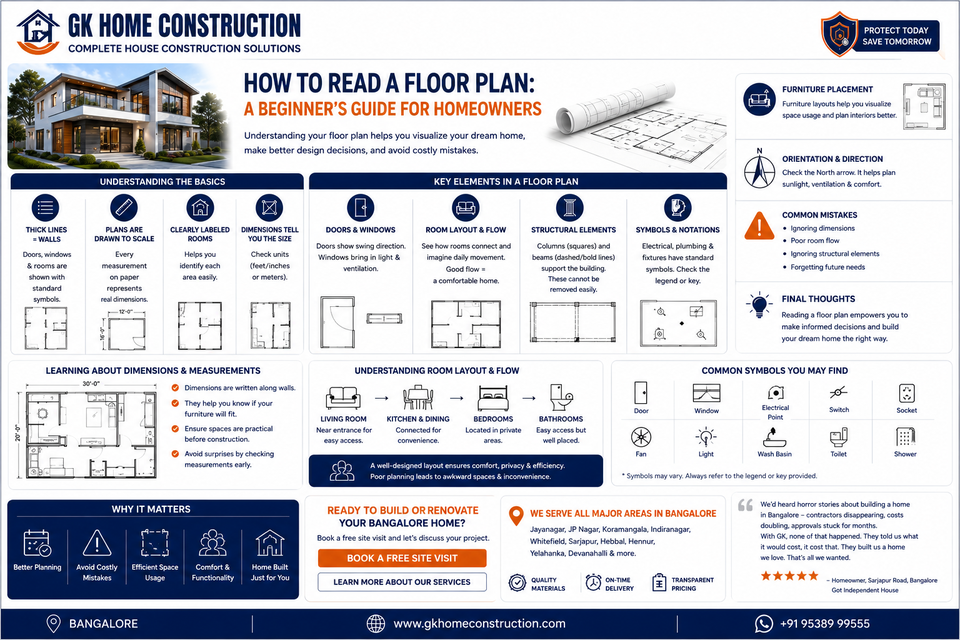
How to Read a Floor Plan: A Beginner’s Guide for Homeowners
When you’re planning to build your dream home, one of the first documents you’ll come across is a floor plan. For many homeowners, especially first-timers, floor plans can look confusing with their lines, symbols, and technical markings. However, understanding how to read a floor plan is essential—it helps you visualize your future home, make better design decisions, and avoid costly mistakes during construction.
A floor plan is a scaled drawing showing the home's layout from above, including rooms, walls, doors, windows, dimensions, and sometimes furniture. Learning to interpret it transforms floor plans from daunting blueprints into valuable tools for design decisions.
Understanding the Basics of a Floor Plan
A floor plan may appear as lines and shapes, but each has a purpose. Thick lines represent walls; doors and windows use specific symbols. Clearly labeled rooms make it easier to identify each area.
One important thing to remember is that floor plans are drawn to scale. This means that every measurement you see corresponds to real-world dimensions. For example, a 10 mm line on paper could represent 1 meter in actual construction. Understanding this concept helps you accurately visualize room sizes and spacing.
Learning About Dimensions and Measurements
Dimensions are one of the most critical parts of a floor plan. They tell you the exact size of each room, wall, and opening. These measurements are typically written along the edges of walls and between structural elements.
When reading dimensions, pay attention to units—most residential plans in India use feet and inches or meters. Knowing the size of a room helps you determine whether your furniture will fit comfortably. For example, a bedroom that measures 10x10 feet will feel much smaller than one that measures 12x15 feet.
Proper understanding of dimensions also ensures that you don’t face surprises during construction. Many homeowners overlook this and later realize that spaces feel cramped or disproportionate.
Identifying Doors and Windows
Doors and windows are represented by standard symbols in floor plans. A door is usually shown as a gap in the wall with an arc indicating the direction it opens. This arc is important because it shows how much space the door will occupy when opened.
Windows, on the other hand, are typically shown as thin lines within walls. Some plans also include details like window size and sill height. Proper placement of windows plays a major role in ventilation and natural lighting, especially in cities like Bangalore, where climate and airflow matter.
Understanding these symbols helps you visualize how movement will happen inside the house and how light and air will flow through different rooms.
Understanding Room Layout and Flow
A good floor plan is not just about individual rooms—it’s about how those rooms connect and function together. This is often referred to as the “flow” of the house.
For example, the living room is usually placed near the entrance, while bedrooms are located in more private areas. Kitchens are often connected to dining spaces for convenience. When you study a floor plan, try to imagine how you would move from one room to another in your daily routine.
A well-designed layout ensures comfort, privacy, and efficiency. Poor planning, on the other hand, can lead to awkward spaces and inconvenience.
Recognizing Structural Elements
Apart from rooms and openings, floor plans also include structural components like columns, beams, and load-bearing walls. These elements are crucial because they support the building.
Columns are usually shown as small squares or rectangles, while beams may be indicated with dashed or bold lines. These elements cannot be moved easily once construction begins, so it’s important to understand their placement early on.
Ignoring structural elements can lead to design limitations later. For instance, you may not be able to remove a wall or expand a room if it is load-bearing.
Reading Symbols and Notations
Floor plans often include various symbols and abbreviations that represent electrical points, plumbing lines, and fixtures. For example, you might see symbols for switches, sockets, fans, or wash basins.
While these symbols may vary slightly depending on the architect, most follow standard conventions. It’s always a good idea to refer to the legend or key provided in the drawing. This section explains what each symbol means.
Understanding these notations gives you a clearer picture of how electricity and water supply are planned in your home.
Visualizing Furniture Placement
Some floor plans include furniture layouts to help homeowners understand how spaces can be used. While this is not always part of the structural plan, it’s extremely helpful for visualization.
Seeing a bed, sofa, or dining table drawn in a room gives you an idea of how much free space will be left. It also helps you plan your interiors better and avoid overcrowding.
Even if furniture is not shown, you can mentally place your own items based on room dimensions. This exercise helps you make practical decisions before construction begins .
Understanding Orientation and Direction
Another important aspect of reading a floor plan is identifying the direction. Most plans include a north arrow that indicates the orientation of the house.
This is especially important in a city like Bangalore, where sunlight and ventilation play a key role in comfort. For example, east-facing homes receive morning sunlight, while west-facing homes can get hotter in the afternoon.
Knowing the orientation helps you plan room usage effectively—for instance, placing bedrooms in cooler areas and living spaces where natural light is abundant.
Common Mistakes Homeowners Make
Many beginners make the mistake of focusing only on the appearance of a floor plan without understanding its functionality. A design may look attractive on paper but may not be practical in real life.
Another common mistake is ignoring measurements and assuming spaces will be “big enough.” Without checking dimensions, you may end up with rooms that don’t meet your needs.
Lastly, some homeowners overlook future requirements. A good floor plan should consider long-term needs such as additional storage, workspace, or family expansion.
Final Thoughts
Reading a floor plan is a skill that every homeowner should develop before starting construction. It empowers you to make informed decisions, communicate effectively with architects and builders, and ensure that your home is designed exactly the way you want.