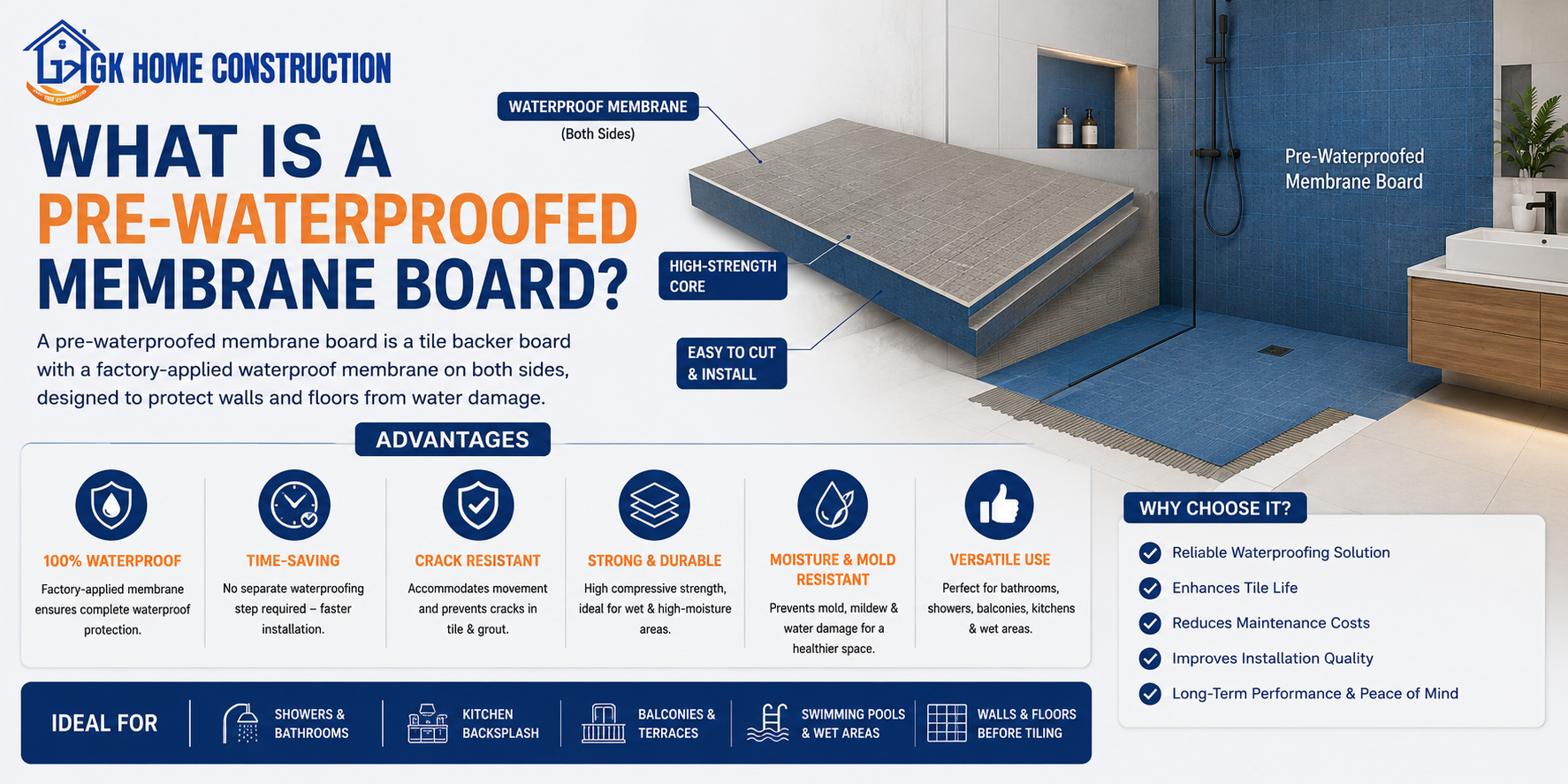
What Is a Pre-Waterproofed Membrane Board and What Are Its Advantages?
Waterproofing is one of the most important aspects of modern building construction. Moisture infiltration can lead to damp walls, mould growth, damaged finishes, concrete deterioration, and costly structural repairs. Choosing the right waterproofing system during construction can significantly improve the durability and performance of a building.
One modern solution gaining attention is the pre-waterproofed membrane board. These boards combine a rigid construction panel with an integrated waterproofing layer, providing both a stable substrate and moisture protection in a single system.
For homeowners, builders, architects, and contractors in Bangalore, understanding how pre-waterproofed membrane boards work can help in selecting a suitable waterproofing solution for bathrooms, balconies, basements, terraces, kitchens, and other moisture-prone areas.
What Is a Pre-Waterproofed Membrane Board?
A pre-waterproofed membrane board is a construction board manufactured with a waterproofing membrane already integrated, bonded, or laminated to the board. Unlike conventional waterproofing, where liquid coatings or membranes are applied separately at the construction site, these boards are supplied as factory-engineered waterproofing panels.
Depending on the product and application, the board may use materials such as cement-based composites, XPS foam, polyurethane foam, fibre-reinforced materials, or other lightweight construction cores. The waterproofing layer may consist of polymer-modified compounds, bituminous membranes, polyurethane-based materials, or other waterproofing technologies.
The main advantage is that the board and waterproofing layer are designed to work together as one system. This can provide a more consistent installation compared with systems that depend entirely on site-applied coatings.
Pre-waterproofed boards can be used in areas such as:
- Bathrooms and shower areas
- Kitchens and utility areas
- Balconies
- Terraces
- Basements
- Swimming pools
- Wet rooms
- External walls and facades
- Areas requiring tile-ready waterproof substrates
How Does a Pre-Waterproofed Membrane Board Work?
A pre-waterproofed membrane board generally performs two functions: providing a stable substrate and preventing water penetration.
The rigid board creates a suitable surface for tiles, stone, render, or other finishes. At the same time, the integrated waterproofing layer helps prevent moisture from reaching the underlying wall, floor, or structural components.
During installation, individual boards are positioned over the required surface and mechanically or adhesively fixed according to the manufacturer’s specifications. Proper attention is required to joints, corners, penetrations, drains, and pipe connections.
Compatible waterproofing tapes, sealants, collars, and accessories are normally used to create continuity between boards. Proper joint treatment is essential because gaps or poorly sealed connections can become potential leakage points.
Advantages of Pre-Waterproofed Membrane Boards
1. Faster Waterproofing Installation
One of the biggest benefits is faster installation. Conventional waterproofing may involve substrate preparation, priming, multiple coating applications, curing periods, and inspections before finishing work can begin.
Pre-waterproofed boards reduce several of these steps because the waterproofing component is already incorporated into the product. Once the boards are installed and the joints and penetrations are properly sealed, subsequent finishing work can often proceed according to the manufacturer’s installation requirements.
This can help reduce overall project duration and improve construction efficiency.
2. Consistent Factory-Controlled Quality
Site-applied waterproofing quality can vary depending on surface preparation, application thickness, workmanship, temperature, humidity, and curing conditions.
Pre-waterproofed membrane boards are manufactured under controlled factory conditions. The waterproofing layer is integrated with the board during production, helping provide consistent dimensions, bonding, and coverage.
However, factory quality does not eliminate installation risks. Proper handling, joint treatment, detailing, and adherence to manufacturer instructions remain essential.
3. Reliable Moisture Protection
The integrated membrane creates a dedicated barrier against water and moisture. This is particularly useful in continuously wet environments such as bathrooms, shower areas, balconies, and basements.
By protecting the substrate behind tiles or finishes, the system can help reduce the risk of moisture-related damage when designed and installed.
4. Lightweight and Easy to Handle
Many waterproofing boards use lightweight cores, making them easier to transport, cut, position, and install than heavier traditional substrates.
Their lower weight can be particularly useful for renovations, upper-floor applications, and projects where reducing additional dead load is desirable.
Lightweight construction materials can also improve on-site handling efficiency and reduce physical effort during installation.
5. Suitable for Tile and Surface Finishes
Many pre-waterproofed boards are designed to provide a suitable surface for tile adhesive, stone, render, or other finishing systems.
This makes them particularly useful for bathrooms, shower walls, kitchen wet areas, and other applications where waterproofing must be combined with a finished wall or floor system.
6. Additional Thermal Insulation
Certain boards manufactured with XPS or polyurethane-based cores can provide thermal insulation in addition to waterproofing.
This can be beneficial in applications where temperature control is important. For example, insulation boards used beneath suitable floor heating systems can help reduce heat loss.
The actual insulation performance depends on the board’s core material and product specifications.
7. Useful for Renovation Projects
Pre-waterproofed membrane boards can be especially useful during bathroom and wet-area renovations. Their lightweight construction and relatively straightforward installation can help simplify upgrades where traditional wet construction would be more disruptive.
Before installation, the existing substrate must still be inspected and prepared properly.
Where Are Pre-Waterproofed Membrane Boards Used?
These boards are commonly considered for areas where moisture protection is critical. Typical applications include:
- Bathroom wall waterproofing
- Shower area waterproofing
- Bathroom floor systems
- Balcony waterproofing
- Kitchen wet areas
- Basement waterproofing
- Terrace applications
- Swimming pool areas
- Wet rooms
- Exterior wall systems
Pre-Waterproofed Boards vs Traditional Waterproofing
Traditional waterproofing systems can still be highly effective when the correct material, preparation, application, curing, and detailing procedures are followed.
The main difference is that pre-waterproofed boards combine the substrate and waterproofing function into a factory-manufactured panel. This can simplify certain installations and improve consistency.
However, they are not a universal replacement for liquid membranes, cementitious waterproofing, polyurethane coatings, or sheet membranes. The best solution depends on the specific location and project requirements.
Why Proper Installation Matters
Even a high-quality waterproofing board can fail if joints, corners, pipe penetrations, drains, or transitions are not properly detailed.
For long-term performance, installation should include:
- Proper substrate preparation
- Correct board fixing
- Sealing of all joints
- Waterproof treatment around corners
- Proper pipe and drain detailing
- Compatible adhesives and sealants
- Correct finishing materials
- Manufacturer-recommended installation procedures
Choose the Right Waterproofing Solution for Your Project
Pre-waterproofed membrane boards offer a modern approach to moisture protection by combining a construction substrate with an integrated waterproofing layer. Their potential benefits include faster installation, consistent factory manufacturing, lightweight handling, moisture resistance, and suitability for many wet-area applications.
For homeowners planning construction or renovation in Bangalore, selecting a waterproofing system should be based on the building location, moisture exposure, substrate condition, finishing requirements, and expected service conditions rather than simply choosing the newest product.
From bathrooms and balconies to terraces and basements, the appropriate waterproofing method should be selected and installed with proper detailing to help protect the building from moisture-related problems.
Contact GK Home Construction
If you are planning to build or renovate a property and are looking for house construction and waterproofing services in Bangalore, GK Home Construction provides construction solutions with quality execution, proper planning, and transparent project coordination.Phone: +91 9538999535
Website: https://gkhomeconstruction.com/
Location: 340, GPR Royale Layout, Huskur Road, Electronic City Phase 2, Near Fruit Market, Bengaluru, Karnataka 560100.